HASTEN TO DO GOOD— A Vayera Reflection

Two weeks ago, I had the opportunity to share a D’var Torah at Congregation Beth Israel Ner Tamid. Though I don’t have the full sermon available, here is an outline in sentence form.

————–

HASTEN TO DO GOOD— A Vayera Reflection

*Recently, I taught at the Paradigm Project Conference, where there were mailboxes available for people write“Kindness Notes”. People were invited to write a note of appreciation. Unfortunately, as a procrastinator with little things, I never took the moments to write down the many notes I had composed in my head.
*It reminded me of something I’ve learned (and relearned) the hard way: when we wait to do something good, no matter how small, we often never do it at all. Delay is the quiet enemy of compassion.

Abraham Ran Toward Goodness
*In Vayera, Abraham models this beautifully. As three guests appear, the Torah describes him as running—not once, but five separate times.
*And in a stunning comment, Rashi teaches that Abraham even asked God to wait so he could welcome his guests properly. Can you imagine? God appears to check in on him after his circumcision, and Abraham essentially says: “Hold on a moment—I have people to care for.”

*Later in the parashah, Abraham “runs” again—this time toward advocacy, standing before God on behalf of Sodom and Gomorrah.
The message is clear:

*When goodness is possible, do not delay.

The Real Meaning of Zerizut
*In our tradition, we call this quality zerizut. It’s not about rushing frantically. It’s about acting at the first honest opportunity.

*A former congregant of mine, Cliff, used to literally run to the bimah whenever he was called up for an aliayh—he would literally run toward the mitzvah. Not because he was in a hurry, but because he was hastening to perform the mitzvah.

Psychology Catches Up to Torah
*Modern psychology has something to say about this too.
Research from David Rand and colleagues — sometimes called the intuition-cooperation effect — shows that when people make decisions quickly, under time pressure, they’re more likely to act generously and cooperatively.

*The longer we deliberate, the more self-protective we become.

In other words:
*Our instinct to help is often our truest self.
*Torah knew this long before social science did. “Hurry to do good” isn’t just spiritual poetry — it’s psychological wisdom.

Redirecting Our Speed
*We move fast in today’s world — racing through email, traffic, deadlines, and obligations. But rarely is our speed pointed toward something sacred.

*Abraham invites us to change that.
To run — not out of panic, but out of purpose.
To move quickly — not through life, but toward what matters.

*Imagine if every time we saw someone struggling, every time we heard a cry for justice, every time we felt that small nudge to check in on a friend, we acted right then.

*Because when we hesitate, we rationalize.
But when we hasten, we humanize.

A Practice for the Week Ahead
*So this week, take a cue from Abraham and Sarah:
When an opportunity arises to offer kindness, generosity, presence, or justice — don’t wait for the perfect moment.
Don’t schedule goodness for later.

*Hasten to do good.
Run — not away from life’s demands, but toward life’s holiness.

*And in that running, may we discover that God is already there, waiting patiently for us to move.

Neilah Sermon: Can We Dance in the Shadows? The Practice of Joy in an Imperfect World

Our final service together on Yom Kippur explored what it means to laugh–and find joy–even amidst tragedy.

You can listen to the audio recording here: https://recorder.google.com/4aeaf4c9-78d3-42b8-8b0e…

There’s a story in Bava Metzia in the Talmud—the Tanur shel Achnai, the Oven of Achnai. It’s perhaps one of the most well-known stories, often told and retold. I’ll summarize it briefly.

There was a debate among the rabbis about whether or not a particular type of oven was kosher. All of the rabbis said no—except for Rabbi Eliezer, who said yes. The group of rabbis, who served as the legal arbiters at the time, stood firm in their decision: the oven was not kosher. Rabbi Eliezer disagreed.

So Rabbi Eliezer said, “If I am right, let this river flow backward.” And the river began to flow backward. But the rabbis replied, “No proof can be brought from a river.”

Rabbi Eliezer then said, “If this carob tree agrees with me, let it be uprooted.” And according to some witnesses, the tree flew 100 cubits; according to others, 400 cubits. But again the rabbis said, “No proof can be brought from a carob tree.”

Rabbi Eliezer pressed further: “If the walls of this beit midrash—this house of study—agree with me, let them collapse.” Immediately, the walls began to fall inward. You might imagine that by this point, at least some of the rabbis would have given in. But not Rabbi Yehoshua.

Rabbi Yehoshua stood and rebuked the walls: “When scholars are debating matters of Torah, what right do you have to interfere?” In honor of Rabbi Yehoshua, the walls stopped falling. But in honor of Rabbi Eliezer, they did not return to standing fully upright. And the Talmud teaches that the walls of that beit midrash remain slanted to this day.

Finally, Rabbi Eliezer said, “If I am right, let Heaven prove it.” And a heavenly voice proclaimed: “Don’t you know that in all matters, the law follows Rabbi Eliezer?”

At this point, you might think the rabbis would yield. God’s voice had spoken, after all. Imagine it: the river flows backward, a tree flies through the air, the walls collapse around you, and then God’s own voice declares you’re wrong!

And yet, in the face of this, Rabbi Yehoshua stood again and said three simple words from Devarim (Deuteronomy): Lo ba-shamayim hi—“It is not in the heavens.”

In other words: God, You gave us the Torah. You entrusted it to us—to live by, to interpret, to apply. Which means You also gave us the possibility to misinterpret and misapply. The Torah is now in our hands. It is no longer in the heavens.

This was possibly the most rabbinic—and the most polite—way of saying to God: Butt out. You don’t get a voice here anymore. This is ours.

We’ve seen God angry before. Throughout the Torah, when the Israelites sin or rebel, God threatens to wipe them out and start over with Moses. We’ve seen God silent before, ignoring the people. But here, God is told directly: You don’t belong in this debate. You have no place here. The Torah is ours now.

How might you expect God to respond? A plague, perhaps? Abandonment? Turning away in anger? Any of those might have made sense.

But the Talmud tells us what happened next. God laughed. God said: Nitzchuni banai, nitzchuni banai—My children have defeated Me. My children have defeated Me.

I love this story because it shows a side of God we don’t often imagine. Quick to anger? Yes. Silent? Yes. But here—God laughs.

The Kotzker Rebbe taught that there are three rungs on the ladder of response to tragedy or fear:

Crying out.

Silence.

Laughter.

We can imagine the rabbis in the story crying out in fear, or falling silent in shock. But here we see the highest rung: laughter.

Joy that rises above pain. Laughter that reflects resilience, hope, and the capacity to embrace life even amidst suffering.

I want to be clear: this is not to suggest that crying out or silence are wrong or inappropriate responses. Kohelet teaches us: “For everything there is a season.” At times, crying out is right. At times, silence is right. And sometimes, laughter comes later.

But the ability—even after tragedy—to eventually return to joy is a deep Jewish teaching.

After the Second Temple was destroyed, the rabbinic response was to curtail joy. They banned music on Shabbat and holidays, even at weddings. They silenced laughter. But over time, joy returned. Imagine Judaism without music! We cannot live without joy.

I also think it’s no coincidence that in Israel, Yom HaZikaron, Memorial Day, is immediately followed—without a pause—by Yom HaAtzmaut, Independence Day. This was deliberate. The message: even in the face of loss and grief, the ultimate response is celebration.

That is deeply Jewish. Not always the first response, not always the easiest, but ultimately: how do we return to joy? How do we laugh again, even when the world feels darkest?

The Kotzker Rebbe himself lived through immense suffering. And he taught that joy is not about ignoring the shadows. It is about finding sparks of light within them. His student, Rabbi Nachman of Breslov, taught: “It is a great mitzvah to always be joyful.” This doesn’t mean we deny pain or ignore tragedy. It means we seek out the laughter that makes survival, and even hope, possible.

As Yom Kippur 5786 draws to a close—just a little over an hour left—perhaps we’ve spent this day, or the past ten days, or the past month of Elul, in reflection. Perhaps not. Either way, there’s still time.

Some of us have been fasting, some of us haven’t, and some of us should not be fasting for health reasons. That is not a failure—the Torah itself suspends the obligation in those cases.

But all of us, in one way or another, are about to re-enter the world. And my prayer is that we do so with the courage to dance in the shadows, to find light in the darkness, and to embrace life fully.

Not by denying pain. Not by pretending there is no suffering. But by affirming resilience, hope, and joy.

And so, my brachah for each of us, as we enter our final Amidah, is this: May we find within ourselves the sparks of resilience and hope. May we rediscover the capacity to laugh and to love, even when the world seems dark. And may our laughter be all the more joyful when we emerge again into the light.

Yom Kippur morning Sermon: “Can We Dance in the Shadows? The Practice of Joy in an Imperfect World”

On Yom Kippur morning, we reflected on responding to tragedy through silence, the second of three rungs of responding to tradegy according to the Kotzker Rebbe.

Listen to the audio recording here: https://recorder.google.com/4a63fa4e-0438-463f-b140…

Timothy Wilson, a social psychologist at the University of Virginia in Charlottesville, and his colleagues in 2014 recruited hundreds of undergraduate students to take part in what they called a “thinking period.” This was an experiment to test how people manage in silence.

In some of the initial experiments, participants were told: You’re going to sit for five or six minutes in silence. In others: An interviewer will come in shortly. Just wait patiently. In every case, the researchers took away phones, pens, papers—literally everything—so the participants had nothing to distract them. The goal was to see what they would do when left alone in silence.

At one point, the researchers decided to push the experiment further. They left participants alone in a lab room for 15 minutes, in which they had access to a button that, if pressed, would deliver an electric shock. The idea was to test whether people, unable to tolerate silence, would rather shock themselves than simply sit quietly.

Beforehand, in intake surveys, all the participants had said they would pay money to avoid being shocked with electricity. Yet more than 50% of them pressed the button at some point—choosing pain over silence, rather than just sitting quietly, thinking, or meditating.

Last night, I introduced a teaching from the Kotzker Rebbe in response to tragedy and trauma: a ladder with three rungs, representing three responses to suffering.

The first rung is crying out. We explored that last night.

The second rung is silence, which we’ll explore this morning.

The third rung is laughter, which we’ll talk about this evening.

For those who weren’t able to attend each session, I should have them recorded and can share them if you’re interested.

Today, though, our focus is on silence.

We often think of silence as something negative. The Torah says: Lo ta’amod al dam re’echa—“Do not stand idly by while your neighbor’s blood is being shed.” And in our society, especially in this city, we see signs everywhere: If you see something, say something.

Silence, we are taught, is complicity. If we’re silent, it’s as if we ourselves are committing the wrong. Silence, we learn, is bad.

And certainly in this world—even more so in Manhattan—there is almost no such thing as silence. I remember when I first moved here. In my bedroom, the steam pipe went clang clang clang, trucks rumbled down Broadway, sirens wailed. I grew up in Milwaukee, and it took me two months before I could sleep through a night. Eventually I learned how to, but at first, I couldn’t handle it. Silence felt impossible.

And even when we do experience silence, it often makes us uncomfortable. If we’re silent too long, rather than holding eye contact, someone feels compelled to say or do something.

But silence can also be experienced without needing to explain, to fix, or to fill the space.

Sometimes tragedy or trauma brings silence. Sometimes injustice does too. Imagine I say something that feels terribly unjust. Not only do I say it, but to your shock, everyone around you applauds. Your silence in that moment may be a form of protest. A refusal to join in. Silence itself can be rebellion.

Or maybe silence arises from shock. Rather than crying out, your grief or disbelief manifests in quiet.

This is the second rung of the ladder.

And here I think back to Aaron, the high priest in the Torah, who exemplified the power of silence. Aaron, as high priest, could enter the most sacred parts of the Tabernacle. His four sons also served as priests. But two of them—Nadav and Avihu—brought an esh zarah, a “foreign flame,” an unauthorized offering.

The rabbis debate: Were they heretical? Rebellious? Experimenting? Trying to do something good? Simply mistaken? Seeking to usurp Aaron’s power? We don’t know. But whatever the reason, the consequence was death. Nadav and Avihu died in service to God.

You could imagine Aaron crying out in anger, demanding answers. His brother Moses—humble, yes, but also hot-headed—might have done so. You could easily imagine Aaron shouting: God, how could you? These are my sons! They were serving you. Even if they made a mistake, they did not deserve to die.

But the Torah records his response in just two words: Vayidom Aharon—“And Aaron was silent.”

We humans love to make presumptions. We see or hear something, and we jump to conclusions. If someone is silent, we interpret: What’s wrong with him? Does he not love his sons? Does he have superhuman discipline? Did he prepare himself for this possibility?

But silence doesn’t always mean what we think. Silence can be sacred.

It’s not always acceptance of the future. Sometimes it’s simply acceptance of the moment as it is.

Think of a time when you shared something deeply personal, or someone shared with you. And after, there were no words—just silence. Sometimes we babble because we feel obligated to say something, and our words come out clumsy. Sometimes silence is better.

And sometimes the silence of the listener—holding space, nodding, offering presence—becomes the most affirming and loving response of all.

When I think of silence as a response, I remember the first time I was in Israel during Yom HaShoah, Holocaust Memorial Day. And later, on Yom HaZikaron, Memorial Day for fallen soldiers. Both days are marked by a siren.

I remember once driving on the highway with my cousin as the siren began. Everyone stopped. The radio played the siren for one full minute. Complete silence—except for that wailing sound. And when it ended, everyone got back in their cars, jostling for lanes, rushing ahead as always. But for that one minute, there was silence. A collective silence that carried power.

I share all this not to suggest that silence is always the right response. There are times when silence is complicity. There are times when silence is wrong.

But there are also times when silence is sacred, powerful, and appropriate.

And so I invite you, as we prepare to recite the Amidah, to consider what role silence might play for you.

It’s a little ironic, because during the “silent Amidah,” there’s often a murmur as people pray. Silence doesn’t have to mean absolute sensory deprivation. It can mean simply holding space—for prayer, for presence, for the heart.

So as we rise for the Amidah, found on page 596, I invite you to explore silence: Not as absence. Not as complicity. But as a sacred space for your prayer and your heart.

Kol Nidre Sermon: “Can We Dance in the Shadows? The Practice of Joy in an Imperfect World”

On the Kol Nidre, we reflected on responding to tragedy through crying or anger. Even as peace (hopefully) looms in the Middle East, there is still much pain that lingers and trauma that is unresolved.

Listen to the audio recording here: https://recorder.google.com/40819764-ee1c-4647-83d3…

The Kutzker Rebbe taught that, in response to tragedy, there is a ladder with three rungs. At first, we respond to tragedy from the first rung. Then, at some point, we may move to the second rung. And finally, perhaps, we respond from the third rung.

The first rung—the first way that we respond to tragedy—is through crying or crying out.

The second is through silence.

And the third is through laughter.

Tonight, we’ll explore responding to tragedy through crying or crying out. Tomorrow morning, we’ll talk about responding to pain through silence. And tomorrow evening, we’ll turn to laughter. We should also be able to record these talks, so if you’re not able to be here for all of them, hopefully they’ll be available in a few days.

The idea of responding to pain, tragedy, or trauma through crying out is not new in Judaism. In fact, the rabbis almost radically reimagined God after the destruction of the Second Temple in 70 CE. When the Temple was destroyed, the Jews were exiled, dispersed, and scattered. They lost political autonomy and sovereignty.

But more than that—the Temple, the very place where they spoke with God, was destroyed. Effectively, Judaism ended. Their God had seemingly lost in battle, and they no longer had a place to commune with God. One could imagine others saying: “Find a new faith.”

Instead, the rabbis—perhaps with no small amount of audacity—reimagined God through the Midrash.

Because God in the Bible was the military God: leading the Israelites through the desert, freeing them from Egypt, and bringing them into the land we now know as Israel. But that military God had just lost in war.

So the rabbis reimagined our relationship with God. No longer was God the warrior to whom we cried out for victory. Instead, they imagined a God weeping alongside God’s people. A God weeping at the destruction of the Temple, and at the dispersal of Jews outside Jerusalem and Israel.

This is a God who weeps with God’s people. A God, the rabbis understood, who is not ashamed to cry.

When I think about stories in Judaism of crying out in pain, the one that stands out to me most is the story of Rabbi Yohanan and Resh Lakish.

Once, while bathing in the Jordan River, Rabbi Yohanan encountered Resh Lakish, who was then the head of a band of robbers. Different commentators give different versions of what happened, but essentially Rabbi Yohanan said: “Instead of robbing me, let me teach you the ways of Torah, and I’ll give you my sister’s hand in marriage.”

Resh Lakish accepted, reformed his ways, did teshuvah, and became a scholar—a giant of the generation.

At one point, though, Rabbi Yohanan and Resh Lakish had a heated debate in the house of study—over something technical, like the sharpening of a knife. Rabbi Yohanan said to him: “A person always knows their trade.”

Resh Lakish was deeply offended. He said: “What have I done to you, Rabbi? Why would you bring up my past? Why would you throw that in my face? I did teshuvah. I learned with you. I learned at your side, as your colleague. Why would you embarrass me publicly?”

Their feud grew. And in his anguish, Resh Lakish fell ill and died.

The rabbis then wondered: “Who will we send to comfort Rabbi Yohanan?” They chose Rabbi Elazar ben Pedat, known for his wisdom. But every time they debated, Elazar would simply agree with Rabbi Yohanan: “You’re right.”

Finally, Rabbi Yohanan grew frustrated. He cried: “Don’t you think I already know I’m right? That’s why I say it! Where is Resh Lakish? For every point I raised, he would raise 24 objections. And I would raise 24 counterarguments. And through that, we came to a deeper understanding of Torah.”

And then Rabbi Yohanan cried out: “Where are you, son of Lakish? Where are you, son of Lakish?” He wailed until his mind was taken from him, and he was driven to insanity.

We can hear the pain in Rabbi Yohanan’s cry. We can hear the loss of the Jews in exile.

And I imagine that each of us is feeling some measure of pain today. For some of us, life and the world feel in a good place—and that should be celebrated. And yet we may still carry pain. Others may feel our lives are in turmoil, or that the world is in crisis.

And many of us—perhaps most of us—feel some mixture of both. There is much to be proud of, much to celebrate, and also times when we hang our heads in shame, or simply want to cry out and scream because we don’t know what else to do.

And so, our first rung of response—in the face of pain, tragedy, difficulty, and trauma—is to cry.

God cried.

And we, too, grieve for people around the world—from the Middle East to Ukraine, to the church shooting just a few days ago in Grand Blanc, Michigan. Sometimes, the only thing we know to do is cry—for ourselves, for our family, for our friends, for strangers.

And let me remind you: it is okay to cry for yourself. Sometimes we feel guilty: “Others have it worse. How can I cry for myself?” But of course we can. Judaism teaches that before we can comfort others, we must have some measure of comfort in ourselves.

So perhaps tonight we cry for ourselves, so that we have the capacity to help others. Or perhaps we cry for both ourselves and others. Or perhaps, if we feel steady, we can cry for others.

In just a few moments, we’ll recite our first Amidah of Yom Kippur. It is said that God is most receptive to hearing our prayers when we recite the Amidah.

So I invite you: open your hearts. Let any grief or pain you are holding pour out—for yourself, for your family, for your friends, and for anyone in the world whom you are keeping close in your thoughts and prayers.

Rosh Hashanah Sermon: “From Vengeance to Teshuvah: Transforming Pain into Possibilities”

On the first day of Rosh Hashanah, we explored how teshuvah—the act of repair and reflection—is not about revenge or punishment, but about opening ourselves to transformation and new possibilities.

Read the transcript or listen to the audio recording here: https://recorder.google.com/19390142-af9a-422a-ae34…

I don’t know that I’ve ever told this story in full before. I believe I was in sixth grade when I kicked Aaron’s violin. I can still see it in slow motion: it bounced off one wall, then another, and crashed to the ground.

Aaron was in fourth grade. I was in sixth.

To this day, I have no idea what motivated me to do it. I cannot give you a concrete reason. Aaron was great. We actually know each other still—both of us live in Milwaukee. He’s a wonderful person. I don’t think he’s ever mentioned it. I don’t think I’ve ever brought this up with him. I probably should—especially now that I’m talking about it. After all, it’s the High Holidays—we’re supposed to do teshuvah, right?

But I don’t know what drove me to do it. What I do know is that looking back on my life, even as a sixth grader, I was in a lot of pain. I was in turmoil.

And something must have happened that day. Aaron and I were practicing a duet for our school with our violin teacher, Sigrid Gullickson. (I don’t remember many names from childhood, but I remember Sigrid’s—she was a wonderful teacher.) Somehow, in the midst of that practice, the pain inside me turned into anger. And I needed somewhere to put that anger. I needed someone to blame. I needed someone else to feel the pain that I was feeling.

So at one point, when Aaron brought his violin down off his shoulder and was just holding it casually, I kicked it. And I can still see it: bouncing off one wall, bouncing off another, and landing on the ground.

Somehow—almost impossibly—the only damage was that the bridge snapped. For anyone who plays violin, you know the bridge is just a small wooden piece, about an inch and a half wide and an inch tall, that lifts the strings off the neck so that when the bow crosses them, sound is made.

I don’t remember what it cost—maybe $10, $15, $20. But all things considered, financially, I got off pretty easy.

That’s the story of what really happened. But that’s not the story I told anyone else. The story I told was the kind that only makes sense to a sixth grader trying to get out of trouble. Here’s how it went:

“Yes, I was frustrated. Yes, I kicked my foot forward. But I stopped my foot before it hit the violin. Aaron, not knowing what I was doing, just happened to bring his violin into the path of my foot, and it accidentally hit.”

Judge Judy would not have been impressed.

The truth is, I was in tremendous pain. It had nothing to do with Aaron.

And the truth is, we are all in some sort of pain. That doesn’t mean pain dominates our lives. It doesn’t mean there is no joy. And it doesn’t mean we haven’t worked hard to overcome the pain we carry. But we are all carrying some.

Sometimes it’s something small—like being cut off in traffic. (That

one still gets me. I’ve done a lot of work on my anger, but drivers? That’s still my trigger.) Sometimes it’s more serious: personal health, caring for a loved one, a strained relationship, financial stress, professional pressure. And sometimes it’s the bigger picture: the state of our country, the world, the Middle East, terrorism, hostages, displacement, suffering.

Pain is everywhere—from the mundane to the monumental.

And when we are in pain, anger is a natural response. Blame is a natural response to anger. And when we blame, we often crave vengeance.

Pain → Anger → Blame → Vengeance.

Blame feels good, at least in the moment. It gives us somewhere to put our pain. Sometimes it even lets us avoid what’s really going on inside us. “It’s Aaron’s fault I kicked his violin,” meant I didn’t have to face that, even as a sixth grader, I was in turmoil.

But deep down, we know: pain, anger, and blame almost never lead to healing or healthier relationships. And vengeance? That’s the final step in the cycle. Sometimes we call it vengeance, sometimes justice, sometimes “comeuppance.” But we want the person we blame to feel what we feel.

Think of the driver who cuts us off. We’re furious. We decide it’s their fault traffic accidents exist. We hope they get pulled over—and when they do, we cheer. Why? Because it feels good. That’s the pain-anger-blame-vengeance cycle at work.

And the easiest way to justify vengeance is to dehumanize the person. The less human they seem, the easier it is to wish them harm. We all do it—sometimes even without realizing it.

This is exactly what Rabbi Meir did, according to the Talmud. There were some lawless people in his neighborhood who harassed him every day. One day, overwhelmed, Rabbi Meir prayed that they should die.

But his wise wife, Beruriah, corrected him. (And it’s significant that she is one of the few women named in the Talmud, and often held in equal or greater esteem than her husband.) She said, “You’re misinterpreting the verse in Psalms. You read it as, ‘Let sinners cease from the earth.’ But it should be, ‘Let sins cease.’ Don’t pray for the people to die—pray for them to repent, for their sins to cease. Then they will no longer be sinners.”

Rabbi Meir prayed in this new way, and indeed, the people repented.

This is the Jewish way.

We don’t rejoice when our enemies suffer. We know this from the Pesach seder. When we recite the ten plagues, we dip our pinky in the wine or grape juice, lessening our cup of joy—because our joy is diminished by the suffering of the Egyptians.

The Jewish way is teshuvah—repentance. Forgiving others.

Forgiving ourselves. Not excusing bad behavior, but releasing ourselves from the pain and anger we carry.

Tonight, as we welcome 5786, let us strive to release some of that pain, anger, and desire for vengeance.

It will not be easy. It is perhaps the hardest task of all. And yes, when we let go, it may leave a hole. Sometimes we almost miss the pain—it has been with us so long.

Tomorrow, we’ll talk more about how teshuvah can begin to fill that hole. But tonight, as we prepare to recite the Amidah, I invite you to set your intention. The Amidah is the central, private prayer of Judaism. If you want, use it as a moment to ask: How can I let go of some of the pain and anger I carry?

Or, if you already have another intention—hold that close.

May these prayers, and these days, guide us toward a little more balance, a little more peace, a little more joy, health, prosperity, and love in the year ahead.

Ruth Bader Ginsburg, Righteousness, and Dying on Rosh Hashanah

TRANSCRIPTION:

For many of us, our Jewish New Year of 5781 began with the news of Justice Ruth Bader Ginsburg’s passing. Putting politics aside, she dedicated her life to public service and advocacy, and she was a titan in advancing gender rights.

Beginning Rosh Hashanah with such upsetting news is emotionally jarring. Any time that we in are in a heightened emotional state — for a good or for a distressing reason — we as human beings struggle when another highly-charged event occurs. Imagine seeing a bat mitzvah girl faint as she steps up to the bimah to lead services or seeing a Torah fall out of the Ark on the High Holidays. Imagine being at a wedding when a guest has a heart attack or at a funeral hearing the cheers of the baseball game from the field across the street. Just as our bodies cannot be in two physical places at once, so too is it unnerving for our emotions to be pulled in multiple directions.

This, I believe, is why Twitter, Facebook, High Holidays teachings, and text messages have shared the common thought ascribed to Judaism: Dying on or right before Rosh Hashanah means that the deceased is a righteous person.

But here’s the truth: There is no Jewish source of which I am aware that says that. None. We are taught that dying on the date of your birth, as we are told that Moses did, is a sign of righteousness and that dying on the eve Shabbat is a good omen. In the case of Moses, we are looking to elevate the one who died on their birthday by comparing them to the person most closely connected with God in all of Jewish history. For those passing right before Shabbat, we are retroactively calling it a good omen. In both cases, we are simply following a basic human need: meaning-making.

This is certainly not a bad thing! We as human beings are hard-wired to make meaning of seemingly disconnected or random events. Processing everything that we experience in a day as isolated events is too taxing even for the complex neurology of our brains. And so we seek connections, finding comfort in how two disparate events relate to each other.

I believe that is the emotional impetus for the idea that one who passes on or just before Rosh Hashanah is a righteous person. It creates meaning and imparts comfort rather than serves as a reward for their righteousness. Around the High Holidays — when we are in a unique state of introspection and reflection — it is not only understandable but perhaps even necessary to make sense of the passing of Justice Ginsburg — who could rightfully be called righteous! — as we ourselves are praying for our own health and happiness.

Perhaps Judaism already has the formula to help us navigate two simultaneous and emotionally-charged events. After learning of someone’s passing, we say, “T’hi nishmatam tzrurah bitzror ha-hayyim. May their soul be bound up in the bond of life.” As we continue to celebrate our New Year of 5781 and prepare ourselves for the Day of Atonement, may the righteousness of Justice Ginsburg — and of all those who passed in 5780 — inspire us to reach our capacity as individuals and, in turn, as a community.

Shanah tovah!

My Trip to Israel: Seeing a Man Who’s Bought Fruits and Vegetables

“What did you do?” “Where did you go?” “What did you see?”

These are the natural and anticipated questions. Over this past winter break, I had the joy and privilege of being in Israel with my kids, Matan and Yael, for two-and-a-half weeks. Of course, upon returning, I was excited to share stories of my trip: The ATV ride with my cousin. Making chocolate at the chocolate factory. Getting hit by a car (literally!). And having the honor of officiating at my friends’ twin boys’ b’nei mitzvah at the top of Masada.

I love the stories.

In the back of my mind, though, I constantly rebuke myself. The truth is that the sights, experiences, travels, and sight-seeing in Israel are remarkable but are far secondary to what I love most about the country. It’s the people. It’s specific people.

When I’m asked about my vacation, what I really want to respond is, “The sights were great, but it was spending time my aunt, uncle, first cousins, family, and friends — and my kids, of course! — that made the vacation extraordinary.” Indeed, seeing the places that I have visited dozens of times before or even for the first time was uniquely meaningful because I did it with people about whom I care deeply.

-From the top story of a high-rise apartment building, I saw the full skyline of Jerusalem at night. A stunning photograph for my eyes. The real beauty, though, was watching my childhood rabbi from Congregation Beth Israel, Lee Buckman, point out the sights to my children from atop the roof after visiting with him and Rachel, his wife.

-My “tour” of Netanya was limited to the inside of an apartment building, where all the residents came to the lobby to light Hanukkah candles, as I stood beside one of my middle school Hebrew and Jewish Studies teachers at Milwaukee Jewish Day School, Adina Altshull, and Harvey, her husband. The candles were beautiful, but only because they were lit with them nearby.

-I saw my first professional basketball game in Israel in Hod Hasharon. The game was exciting (I love live sports), but the true joy was watching my friend, Yariv Amiram, play on the team and having other friends — all of us who worked at Ramah Sports Academy this summer, and all of whom live in Israel — meet my kids and me there: Dore Amiram, Bracha Hermon, and her two boys.

-Although I have seen soccer matches in Israel before, this was the first time that I got to see one with a founder of the team and my cousin, Motti Porat. The game was a blowout — a five-nothing win for Beitar Nurdiya — but hearing the story of the franchise and its founding transformed it from a game to a lesson in civic responsibility and activism.

-Being atop Masada is always breathtaking. Being there to serve as the rabbi at the b’nei mitzvah of two boys whom I have known for their entire lives — I officiated at their bris and at their parents’ (Dayna and Arin Hayden) wedding — made the visage of the place the background with their gleaming faces and their sonorous voices the true delight.


-And, first and foremost, seeing my family. My daughter needed to interview me recently for a class assignment, and one of the questions led to my talking about my family in Israel. My response was, “They don’t treat me LIKE family. They are family.” It wouldn’t matter to me where in the world Bashi and Eli; Arale, Keren, No’am, and Yogev (and their dog, Gizelle); Keren, Motti, Ta’ir, and Nohar; and Avichai lived: that is where I would want to visit most and most often. Being with all of them every day of my trip is what makes Israel not just my homeland but a home.

At the University of Wisconsin-Madsion, I studied a poem by Yehuda Amichai called “The Tourists“. Looking only at its last line undermines the impact of the poem in its entirety. Please indulge me, though. Speaking in the first person, the unnamed narrator of the poem notes a tour group admiring arches alongside David’s Tower. The tour guide uses the narrator as a vantage point, suggesting that they look at the arches over the man’s shoulder.

To himself, the narrator remarks:

redemption will come only if their guide tells them,
“You see that arch from the Roman period? It’s not important: but next to it,
left and down a bit, there sits a man who’s bought fruit and vegetables for his family.”

Whenever I am asked about my trip to Israel, I tell about what I did and, of course, about seeing my family and friends. The reality is that it’s reversed. On my trip to Israel, I saw my family and friends — and we visited some extraordinary places together.

Remembering and Forgetting

(In the wake of the shooting in New Zealand, I share an amended version of my words to my synagogue, Congregation Cnesses Israel, in Green Bay this past Shabbat.)

In the Jewish calendar, this past Shabbat (Sabbath) is called Shabbat Zahor — the Sabbath of Remembering. The name comes from three verses of the Torah that we read as an additional reading during Saturday morning services. Those verses remind us to remember the brutal of the Amalekite people against the Israelites and also to blot out the name of Amalek.

Those seem like contradictory injunctions. How do we simultaneously remember and forget? I believe that the Torah is instructing us to remember the vicious attacks and also do our part to eradicate evil.

The horrific and inhumane attacks in the mosques in New Zealand reminds us far too painfully that we must continue to do our part to combat the evil and terror and that still plagues our world and remains as an affront to our humanity. It also brings back, in my mind, the painful memories of the recent attack at the Tree of Life synagogue in Pittsburgh.

Despite my broken heart, another memory — one of warmth and comfort — also comes to mind. I recall the herculean effort of the Muslim community in Pittsburgh to raise funds for the Pittsburgh synagogue and also its inspirational offer to personally serve as standing guards to help insure a safe praying space for Jews. I also recall the inspiring gathering here at Congregation Cnesses Israel after the Pittsburgh shooting, where hundreds of Green Bay community members comes to our temple on a Friday night for a night of solidarity and to join us for worship services.

The attacks in New Zealand remind us of our obligation to fight evil and to remember the all-too-present attacks on faith communities in our world. We must also be mindful of the unending and unapologetic love, support, and strength that we offer each other in times of need.

May the love that we bring to each far outweigh the hate, and may it inspire us to do everything in power to make this world one in which we are all free and safe to to express our faith in worship.

Growing, Cutting, and Donating my Hair: A Reflection

 Pride, Pressure and Principle:
A Reflection on My Eighteen Months of Growing, Then Cutting, Then Donating My Hair


            My unintended personal journey began almost four years ago, when I was then the Associate Rabbi of Westchester Jewish Center in Mamaroneck, NY.  I had a realization, one which, perhaps, should have been self-evident to a pulpit rabbi but one which nonetheless forced me to reconsider one of my basic assumptions about Jews and Judaism. 

            As all pulpit rabbis do in the weeks leading up to the High Holidays, I was considering the topics and content of my sermons.  I thought to challenge my community by encouraging each member of my synagogue to accept upon himself or herself one new mitzvah or Jewish ritual for that upcoming year.  How hard could that really be, I wondered to myself.  After all, in Judaism, there are many rituals that are simple, accessible, and meaningful.  It should not be any problem simply to select one and try it for one year!

            Around the same time, a new kosher meat product was on the market – kosher meat from Grow and Behold.  It represented everything that I was looking for in kosher meat:  locally grown, organic (by the spirit and not just by the letter of the law), free-range (also by the spirit and not just by the letter of the law).  It was delivered fresh, and it tasted delicious.  I remember cooking the chicken the one and only time that I purchased meat from them.  I did not marinate or dress the chicken; I was curious to taste fresh organic meat for the first time, and its taste did not disappoint.

            Yet the experience did.  I had anticipated that I would feel better about eating meat.  After all, the animals were given a good life, not mistreated, and the environmental impact was kept to a minimum.  Instead, I had to face a personal truth:  I believed that, for me, eating meat was wrong.  And I had known it for years, yet I had made no change to my diet.  Why?  Simply because making that change, I permitted myself to believe, was too hard.

            For most Jews, this is how they perceive Jewish ritual.  They often want to participate and try something new, but change is difficult.  Nonetheless, here I was, about to stand in front of almost two thousand members of my community at Rosh Hashanah and ask and expect them to do something – that is, make a change in their personal and religious practice – that I had put off doing for nearly a decade.  Thus, I committed to becoming a vegetarian for one year.

            It is now coming up on four years since that Rosh Hashanah sermon.  Truthfully, I have eaten meat about a half-a-dozen times, but I still hold to my vegetarian practice and lifestyle.


***********************************


            My last haircut was on Monday, November 12th, 2012, almost eighteen months ago.  I was at the home of Michelle, a friend and a parent of a student at Milwaukee Jewish Day School, where I have worked as the Director of Jewish Life & Learning and School Rabbi for almost two years.  I was at her house for two reasons:  my friend’s daughter and my son were in the same Junior Kindergarten class at MJDS, and Michelle was going to give me a haircut.

            In college, I wore a half-inch buzz cut for years.  I admit that I have always harbored a not-so-secret desire to grow my hair long – not the socially acceptable down-to-the-ears length at which I had typically kept my hair for the past decade – but long.  Societal pressure held me back.  I was going to be a rabbi, I reminded myself.  I am a rabbi, my congregation reminded me.  It was a rare case for me of conceding to societal norms.  But, I wisely and with great dismay did not grow out my hair.  Undoubtedly, this was not a case of personal conviction but rather preference, and, having accepted a public position with the expectation of an accepted norm of appearance, I did not press the issue. 

And so, with my usual personal reluctance, I sat down one-and-a-half years ago for a haircut in Michelle’s house.  She gave me a wonderful haircut – as far as haircuts go, I loved it!  But, I looked in the mirror, and the reflection began to mock my principles.


***********************************


I do not have a working television in my house, and it has been nearly two years since I last plugged in my television.  I have a twenty-nine inch tube TV that I received as a gift in 1997 for my twenty-first birthday (it still works, but I do not have the digital adapter for it), and I have an antenna which I can plug into my laptop to watch basic channels with intermittent reception.  Still, giving up a working TV in my house was a much more dramatic change for me than becoming a vegetarian.

I love television, I love TV series, I love movies, and, most importantly, I love sports.  When I was a synagogue rabbi, most nights, I would come home from work and would be the only person awake at my house – my family was already asleep.  I would turn on ESPN, watch whatever was on, and eat dinner, do e-mail, or complete some housework with sports on in the background until I went to sleep. 

Of course, living in New York and maintaining my Packers, Brewers, Bucks, and Badgers loyalties was often a challenge.  Inevitably, I purchased the Sunday Ticket and MLB pass to watch Packers and Brewers games, respectively, and I only subscribed to a cable package that would offer me the Big Ten network.  As the rabbi of a synagogue, I rarely had the opportunity to watch my favorite sports teams live, so I would commit the shameful sports-fan sin of taping a game and watching it later.  It wasn’t a perfect system, but it worked.  And I got to watch my sports on television.

Until I moved back home to Milwaukee nearly two years ago and did not plug in my TV.


***********************************


I decided that it was time to cut my hair right now for one simple reason:  I found a place that would accept hair that was six inches long.  Most organizations require donated hair to be at least eight-inches in length, and I would not return to a half-inch buzz in order to donate my hair.  I then stumbled upon 360-hair.com, which works in partnership with the Canada Cancer Society.  360-hair.com makes wigs and hair extensions, and it personalizes – for free – wigs for children with cancer.  That alone is enough to encourage me to donate my hair to them; the fact that I do not need to wait to meet the six-inch length minimum requirement locked it in as my choice.  I was set to cut my hair in front of the entire school on Friday, April 4th, 2014.


***********************************


I knew that I could use my time more productively in the evenings than by watching sports on TV or by having movies on in the background.  There were other uses of my time that I knew would be better for my own personal growth, development, and fulfillment.  And, with two young children at home, I did not want them to fall into the same habit that I had:  coming home, mindlessly turning on the television, and living my life with the TV’s omnipresent glow in my home. 

Now, I will occasionally invite myself over to a friend’s house to watch a Packers game, this weekend’s Badgers Final Four appearance, or other sporting events.  But, my evenings are much more fulfilled.  I taught myself guitar (in just enough time for my live Purim performance at MJDS in 2013!); I read as voraciously as I had before; I returned to my passion for making puzzles; I took an Improv class at ComedySportz; and I had time for personal reflection and introspection.  I did watch the occasional series on the internet or on Netflix, but my personal journey – which began with becoming a vegetarian and continued with unplugging my television at home – was crystallizing in purpose.  I was making conscious decisions to make daily choices which upheld my principles and my convictions.

And it made me feel good.


***********************************


I made my intent to grow my hair, cut it, and donate it public.  I wrote an article and distributed it to the entire school community in our school’s weekly newsletter, Yom HaShishi.  The initial purpose was relatively simple yet personally meaningful.  I believe in conserving and re-using as much as possible.  I am renowned for bringing what others would consider scraps of paper for taking notes.  I shut off lights habitually and militantly in my house.  I will use the same washable glass all day rather than taking a new one at each meal.
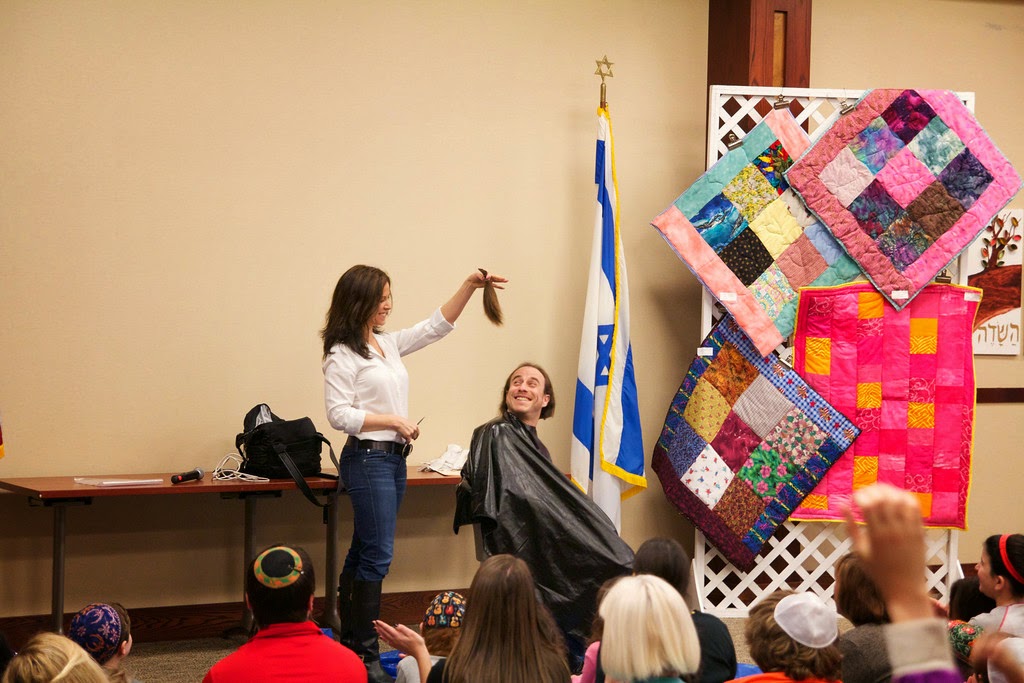
Of course, none of these practices is particularly impressive or impactful on the larger world.  But, I am trying to adapt my lifestyle to reflect a core personal tenet:  protecting our world demands personal accountability.  For me, that means re-using what I can.

At first, it struck me that hair is no different.  If I have the opportunity to re-use my hair rather than discard it, then that is fundamental to my convictions.  How could I notgrow it and donate it?  Upon reflection, however, I realized that it is categorically different:  by donating my hair, I am not only acting in a microcosmic way as a guardian of the earth, but I am also performing another mitzvah.  I am, in one small way, giving dignity to someone suffering from cancer.  A two-for-one mitzvah opportunity! 

            Throughout the eighteen months, I was surprised at how meaningful this decision became for me.  Every time that I saw my hair, every time that it dripped into the bubbler as I took a drink, every time that, when rolling on the floor with my children, one of them stepped on it pulling it painfully, I felt a sense of pride.  I knew that I was adhering to my convictions – not the one of personal preference but the one of bettering myself and improving the world in my own small way.  I was living out the life and ideals that drove me internally.  Moreover, I was sending a message to the students with whom I worked every day:  convictions can and should drive you despite what other might say or think.

            Throughout those same eighteen months, though, I was also surprised at the unintended impact that my choice had made.  To be sure, most people who came up to me were both curious and supportive.  How much longer do you have to grow out your hair?  Where are you donating it?  Have you grown to like it?  Indeed, more than a handful of people would even whisper, I like your hair longer or I have always wanted to do that, too.  Of course, the fact that they would make those comments to me confidentially confirmed a growing suspicion:  a rabbi with long hair – even if being grown for a good cause and with public knowledge – pushed societal conventions more than anticipated.

            Some of the pushback that I received was open.  A few people would suggest, kindly though forcefully, that my choice was inappropriate as a rabbi and as a representative of MJDS.  I appreciated their directness, and I welcomed the opportunity to share my passion and conviction.  While some remained opposed to my choice, I believe that these conversations led to a greater understanding of my motivation and a better appreciation for my principle.  I came to realize, however, that many there were many more who were confused about my choice and talking – not with me, however, but with each other. 

            Lashon harah (harmful speech) is arguably the greatest toxin in any community.  Upon reflection, I now wonder aloud if I helped cause and create an environment that fostered lashon harah.  Instead of using my conviction as a way to unite a community behind a cause, instead of my personal choice challenging students and adults to live out their principles, I might have fed the culture of gossip.  Was it really worth it, I asked myself often and was often asked.  What started out with tremendous personal pride became a personal and professional battle not to give in to societal pressure.  Indeed, I have never felt more connected with my middle school students, who struggle every day to stand up for what they believe is right in the face of social pressure, as I did during these past few months as my hair continued to grow far beyond traditionally-accepted lengths.

            Despite the challenges that my choice to grow, cut, and donate my hair brought, I feel fulfilled.  I am much more heartened than dismayed, thanks to the tremendous support and encouragement that I received from many in my community.  It was a loud voice, and the aforementioned interest and chorus of encouragement inspired me to see my commitment through to its conclusion and continue to fill me with overwhelming gratitude.

            In the end, if I had to do it over again, I would.  Indeed, I would love to grow it again and donate it repeatedly, though I do not anticipate doing it any time soon (of course, I already imagine the personal lament that I will feel every time I get a future haircut and see the hair discarded…).  But, I feel good.  I feel good that I actualized my core beliefs.  I feel good that I created awareness and conversation – many productive ones in particular with students, with parents, and with strangers.  I feel good that my children, now five-and-a-half and almost three, can both articulate the mitzvot that I am performing.  And I feel good that I modeled for the students at MJDS the value in acting in accordance with one’s principles.  And I thank you, my community, for your tremendous support and encouragement along the way.

 [You can watch the video my hair being cut here.]

The Particularistic and the Universalistic: Religion in 21st Century North America

(sermon delivered on June 9th, 2012)
            Shabbat shalom.
            I would like to talk about two things this morning that have been on my mind.
            The first is particularistic and the second universalistic. 
            First, the particularistic:  Judaism.  In talking about Judaism, I do not want to talk about numbers.  We give much more weight to numbers than is deserved.  Rather, I want to talk about purpose and impact.  Because in those regards, Judaism is passionate, thriving, engaging and indispensable.
            But, first, some personal history.  When I applied to rabbinical school in 2000, I wrote one of my admissions essays on the constant dynamic tension that I felt wearing a kippah(yarmulke; head covering) all the time.  I was most concerned about wearing my kippah at a non-hekhshered restaurant, a bar or a night-club or dance-club.  While my essay focused on the personal, professional and religious implications of such a choice, my conclusion ultimately reflected a core ideological tenet of the Judaism.
            I realized that, for me, it was ultimately less important what I determined to do than that I recognized that I would be constantly engaged in that process of determination.  The answer was less important than the question.  The resolution was less important than the ongoing struggle.  Indeed, it is that very ongoing struggle that ultimately brought and continues to bring me the most comfort.  My kippahis uniquely meaningful to me because I think about it every time that I wear it.  I think about what it means to be a public religious figure and what it means to be a Jew.  I think about God.  Had I decided with certainty one way or the other about when to wear and not wear a kippah, I would think of those other things much less regularly.  Absolutism would be disengaging; certainty would be stifling:  my personal and religious life would be much emptier as a result.  Thus, the constant dynamic tension of when to wear a kippah epitomizes the strength and passion of my religious conviction.      
Of course, this tension translates to all facets of Judaism.  Are we absolutely sure that praying the traditional words of the siddur (prayer book) is what the Torah and God commanded us to do to replace sacrifices?  Are we absolutely sure that the prohibition of boiling a kid in its mother’s milk demands eating meat from kosher slaughterhouses rather than demanding that the violation of the ethical treatment of animals in those slaughterhouse prohibits us from eating their meat?  And, if we’re going to be honest, we also need to ask:  are we absolutely sure of what God is, of what God wants, or even of God’s existence?  Are we absolutely sure?
For some of us, we might be able to answer a definitive “yes” to one of more of these questions.  For others of us, we might even be able to answer “yes” to all three.  But, I suspect that, for most of us – including myself – “yes” is a difficult if not disingenuous answer to give.  “Yes” might be easy, and “yes” might be convenient.  But, it is not likely genuine, and it is not definitely Jewish.
In Judaism, the response to these questions is no different than my response to my struggle about when to wear a kippah.  Judaism does not deal in absolutes.  Indeed, prayer is more engaging because of its constant dynamic tension:  we want to talk with God, we really do; is how we do it the best and most appropriate way?  Speaking personally, my becoming a vegetarian is more meaningful because of the constant dynamic tension:  kashrut(Jewish dietary laws) is not simply about a seal on food but also about the ethical considerations that the Torah mandates.  And our relationship with God is intimate because of its constant dynamic tension:  the absence of absolute empirical evidence is what demands, creates and sustains our faith.  Certainty is boring.  Certainty is unfulfilling.  And, certainty can be dangerous.  Absolute certainty leads to dogmatism, to theological, ideological and even military warfare.  Ambiguity, however – just the slighting intrusion of doubt – leads to faith, exploration, meaning, understanding, passion, and compassion. 
This is what I want in religion.  I want to be part of a religion that does not shun these questions, that does not seek to impose dogmatic behavior as a substitute for meaningful ideological and theological inquiry and engagement; I want to be part of a religion, of a Jewish movement that does not deny our religious obligations in the name of ethical practice.  I want that tension, that constant dynamic tension.  We need that constant dynamic tension.  People are hard-wired to live in a world of ambiguity and to accept the challenges therein.  We do not deny the complexities of living a traditional religious life in our contemporary society.  We do not resort to dogmatic ideology or practice nor do we deny the value and centrality of religious proscription.  We embrace that tension, we navigate that tension.  We are a movement of integrity and a movement of authenticity.  We are am yisrael, a people who – literally:  that is what the word yisraelmeans! – struggles with God and with our choices.  We are Judaism.
            That was the particularistic; now the universalistic.  Please allow me to take a couple of minutes to read a piece written by Rob Kirby (http://delightmakers.com/news-bleat/wild-elephants-gather-inexplicably-mourn-death-of-elephant-whisperer/; you can also find the post on my Facebook page:  feel free to Friend me and/or to like my public profile page, Rabbi Moishe Steigmann!). 
Author and legendary conservationist Lawrence Anthony died March 2. His family tells of a solemn procession of Elephants that defies human explanation.
For 12 hours, two herds of wild South African elephants slowly made their way through the Zululand bush until they reached the house of late author Lawrence Anthony, the conservationist who saved their lives.  The formerly violent, rogue elephants, destined to be shot a few years ago as pests, were rescued and rehabilitated by Anthony, who had grown up in the bush and was known as the “Elephant Whisperer.”
For two days the herds loitered at Anthony’s rural compound on the vast Thula Thula game reserve in the South African KwaZulu – to say good-bye to the man they loved. But how did they know he had died?…
There are two elephant herds at Thula Thula. According to his son Dylan, both arrived at the Anthony family compound shortly after Anthony’s death. “They had not visited the house for a year and a half and it must have taken them about 12 hours to make the journey,” Dylan is quoted in various local news accounts. “The first herd arrived on Sunday and the second herd, a day later. They all hung around for about two days before making their way back into the bush.” Elephants have long been known to mourn their dead. In India, baby elephants often are raised with a boy who will be their lifelong “mahout.” The pair develop legendary bonds – and it is not uncommon for one to waste away without a will to live after the death of the other.
But these are wild elephants in the 21st century, not some Rudyard Kipling novel… So, how after Anthony’s death, did the reserve’s elephants — grazing miles away in distant parts of the park — know?
“A good man died suddenly,” says Rabbi Leila Gal Berner, Ph.D., “and from miles and miles away, two herds of elephants, sensing that they had lost a beloved human friend, moved in a solemn, almost ‘funereal’ procession to make a call on the bereaved family at the deceased man’s home.”
“If there ever were a time, when we can truly sense the wondrous ‘interconnectedness of all beings,’ it is when we reflect on the elephants of Thula Thula. A man’s heart stops, and hundreds of elephants’ hearts are grieving. This man’s oh-so-abundantly loving heart offered healing to these elephants, and now, they came to pay loving homage to their friend.”
            What were these elephants doing?  Really, what were they doing?  They were paying a shiva call (the period of mourning of the death of a loved one when family and friends come to offer condolences)!  The connection between these elephants and this man was not just physical and emotional.  It was spiritual.  They had no way to know that he had died!  It’s almost unbelievable – but for the fact that it happened.        
            So, why do I choose to conclude my sermon on religion with this story?  Because we are all seeking.  We all yearn for a spiritual connection with others, with God.  And, as we discussed earlier, we all doubt.  But, the relentless companion of doubt is hope, is inspiration.  This story reflects that hope, that inspiration.  There are things in this world that resonate, that are inexplicable, that are binding.  They embody spirituality, and religion is our key, our access card, our password to that very same connection.
            I know what people say the dangers of religion and spirituality are.  But, they are wrong.  Religion and spirituality are not dangerous.  People who misuse and distort religious and spiritual teachings are dangerous.  Similarly, religion and spirituality are not inherently good.  But, those who use religion and spirituality to bring people together, to bring God into this world, to somehow make sense of the two elephant herds’ shiva call:  they – we – are good.  That is what religion and spirituality can bring into this world and into our lives. 
            And, that is why it is such a privilege to be a rabbi, to be a conduit of this kind of religious teaching, to help bring this sense of spirituality into your lives and into our world.    
And so it is my hope and prayer that we all be blessed with many connections, and may our faith and tradition continue to guide us and bring us together.
            Shabbat shalom.