MINDFUL MESSAGE: MAKE TIME FOR WHAT BRINGS US JOY

In this week’s Torah portion, Ki Teitzei, we encounter a rather unusual commandment: When a man gets married, he is exempt from military service for an entire year. The Torah explains that this time is set aside so that he can “bring joy to his wife.”

In modern language, I might understand this as a reminder that when we enter a new marriage or partnership, we should make time to delight in the person we love and in the life we are building together. There are always other things calling for our attention. The Torah tells us that, sometimes, the joy we create together deserves to take priority.

As someone who got married less than two weeks ago, this commandment has taken on new meaning for me. Shara and I had already been together for six years, yet somehow marriage feels different. I find myself feeling the absence of her more acutely when we’re apart. I want to spend time together. I want to make her happy. I want to celebrate this new chapter with her.

And it has gotten me thinking about the way we prioritize our lives.

We all have obligations. Work needs to get done. Errands need to be run. Emails need to be answered. There are always responsibilities waiting for us. And many of them are important. Yet sometimes the things that demand our attention most urgently can crowd out the things that give our lives the greatest sense of joy, grounding, contentment, and fulfillment.

We tell ourselves we’ll make time for those things later. Later, when work slows down. Later, when the kids are older. Later, when the house is in order. Later, when we have fewer things on our plate.

But what if “later” keeps getting pushed further away?

As we enter the month of Elul and begin preparing for the High Holidays, perhaps this is a moment to reconsider what deserves our time and attention. The work of these weeks is not simply to examine what we’ve done wrong or what we need to change. It is also an opportunity to remember what we treasure and ask whether our lives reflect those priorities.

My wedding blessing for all of us this season is that we make time for what brings us joy. That we give ourselves permission to delight in the people we love, to celebrate the relationships that sustain us, and to make space for the experiences that ground and fulfill us.

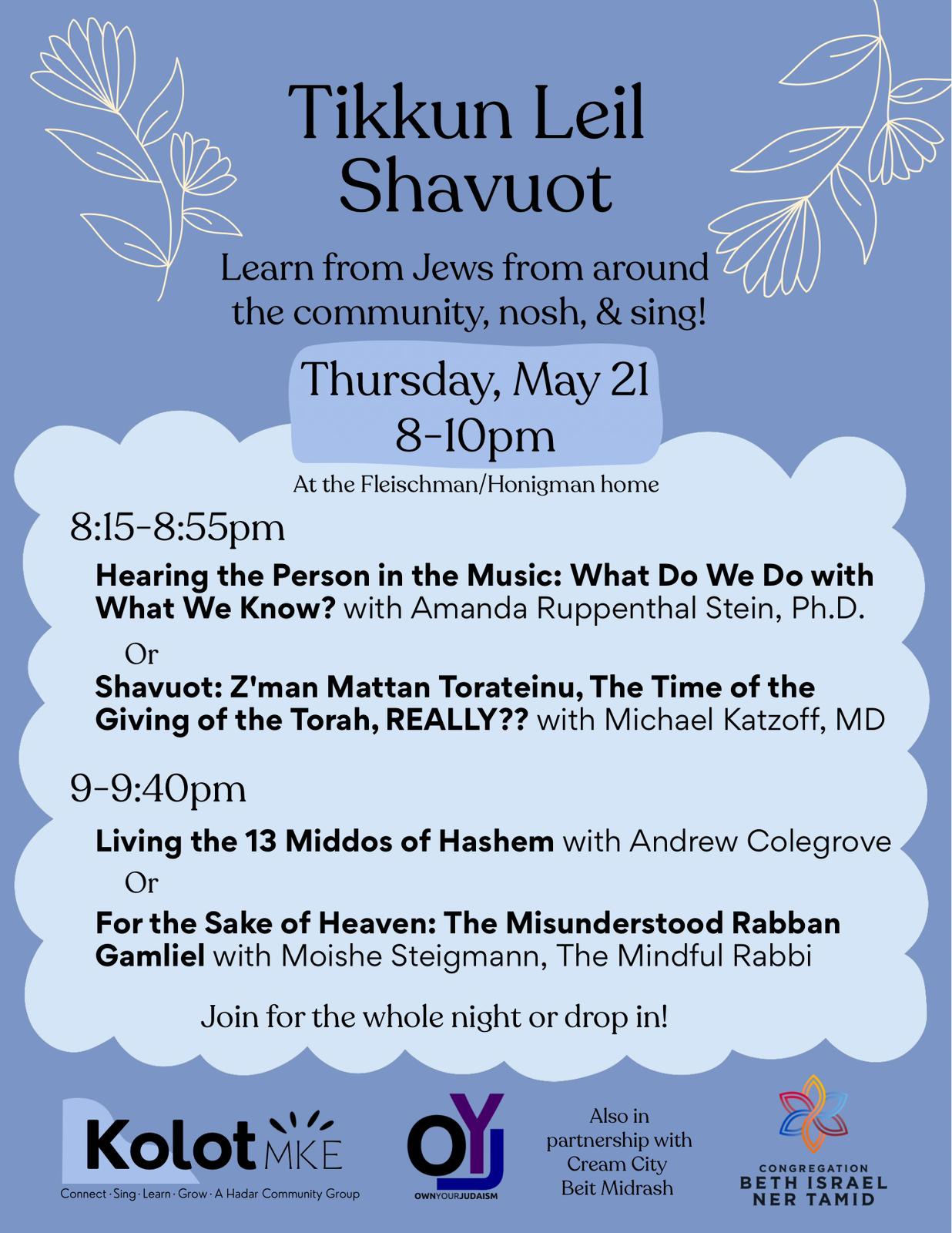
Tikkun Leil Shavout

Thursday, May 21, 8pm to 10pm

Tikkun Leil Shavuot is the Jewish tradition of studying Torah throughout the first night of Shavuot to prepare for receiving the Torah, which is commemorated the next morning.

Join Moishe Steigmann, The Mindful Rabbi, and others as we gather together to learn, nosh and sing! This event is generously hosted at the Fleischman / Honigman home (1852 W Brantwood Ct., Glendale, WI), and co-sponsored by KolotMKE, OYJ, Cream City Beit Midrash, and Congregation Beth Israel New Tamid.

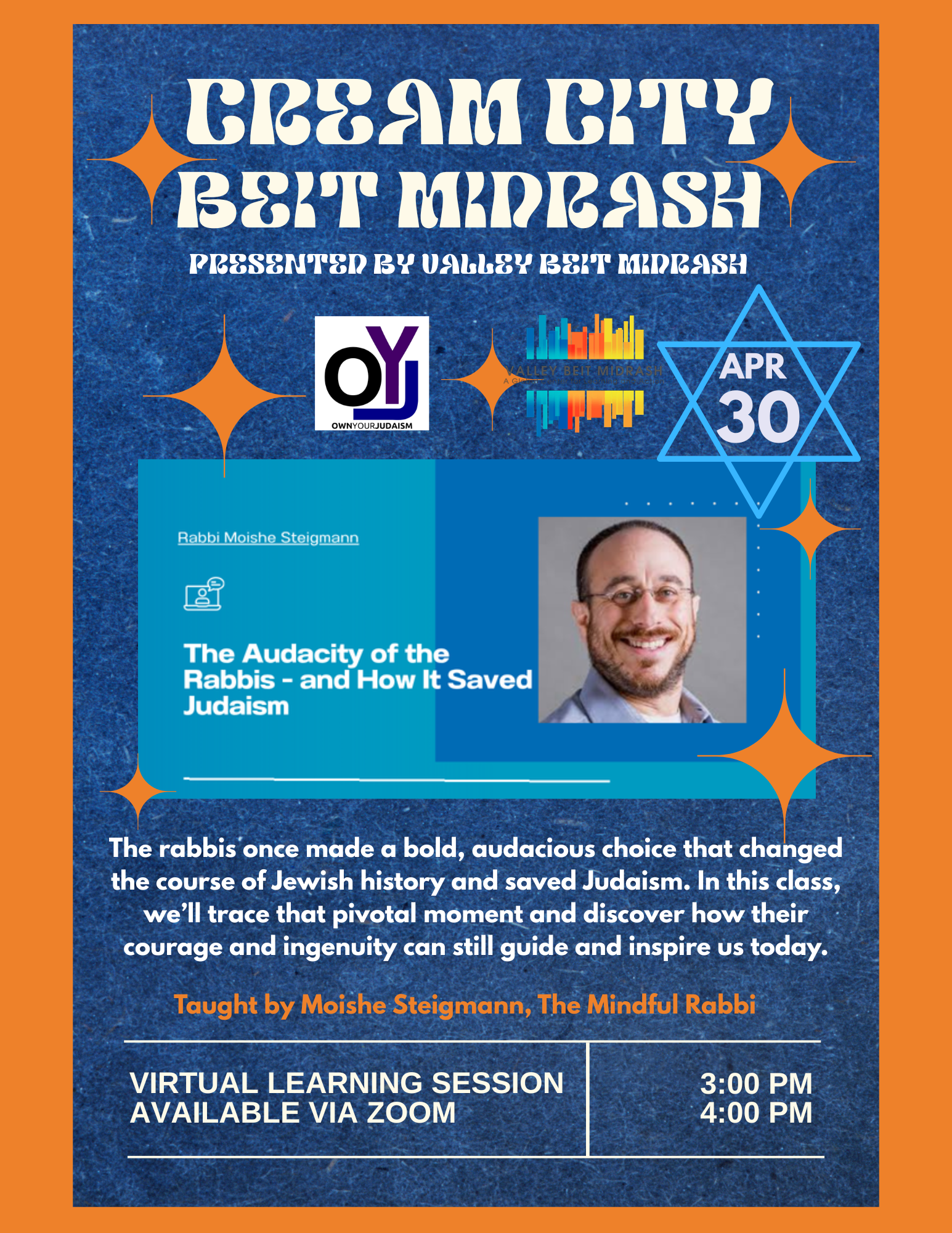
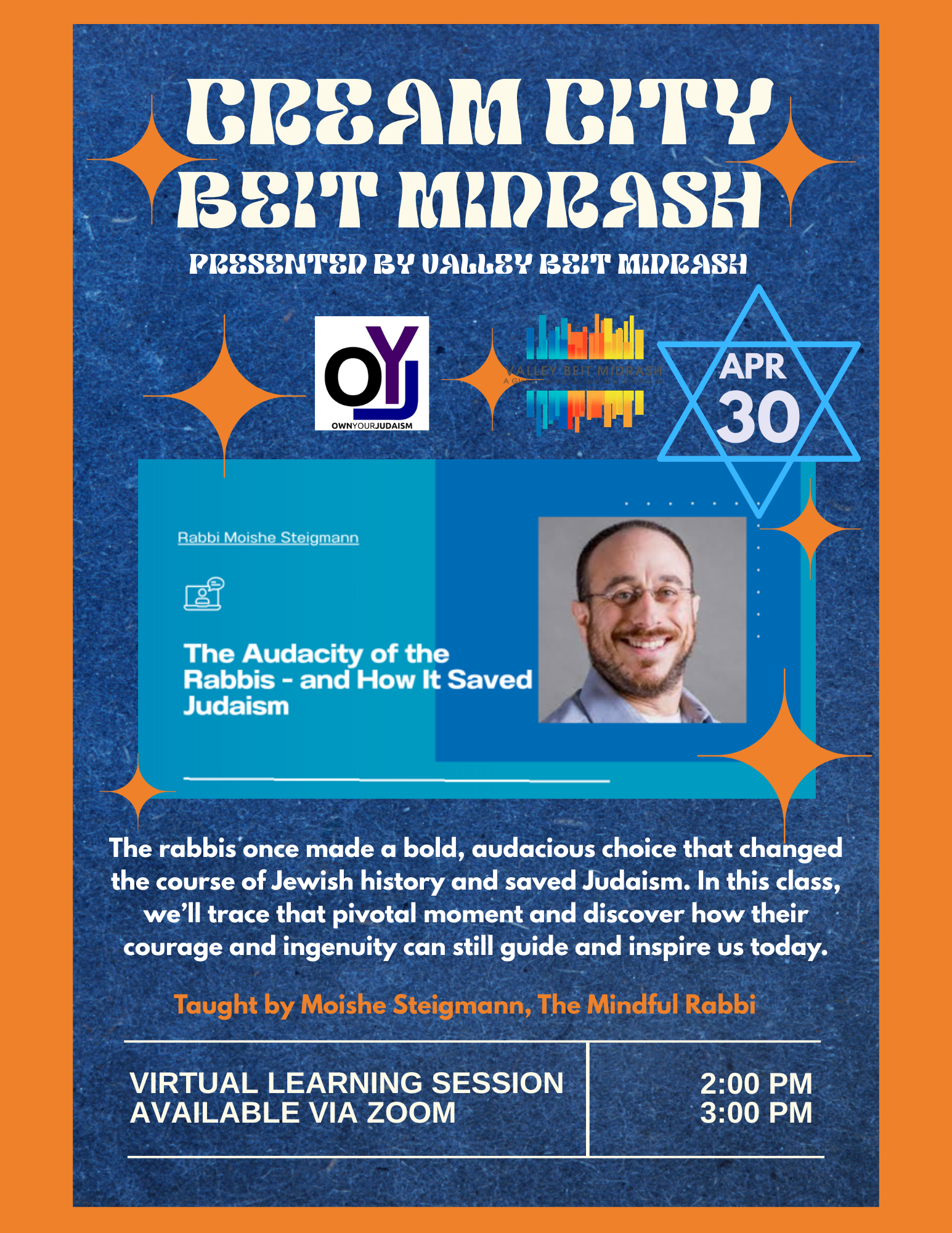
Cream City Beit Midrash Presented By Valley Beit Midrash: The Audacity Of Rabbis – And How It Saved Judaism

ABOUT THE EVENT:

The rabbis once made a bold, audacious choice that changed the course of Jewish history and saved Judaism. In this class, we’ll trace that pivotal moment and discover how their courage and ingenuity can still guide and inspire us today.

ABOUT THE SPEAKER:

Moishe Steigmann, The Mindful Rabbi, is the founder and director of Own Your Judaism and is the director of Ohel Ayalah. He seamlessly blends ancient Jewish wisdom with contemporary mindfulness practices. Through his teachings, writings, and workshops, he continues to influence and lead the conversation on mindful living within and beyond the Jewish community. He also speaks, hosts livestream conversations, and offers Jewish Life Coaching and organizational consultation. Born and raised in Milwaukee, Rabbi Steigmann is a proud father of two children, loves sports, is passionate about living gratefully, and enjoys almost all puzzles and games.

Register Here!

Cream City Beit Midrash: The Audacity Of Rabbis – And How It Saved Judaism

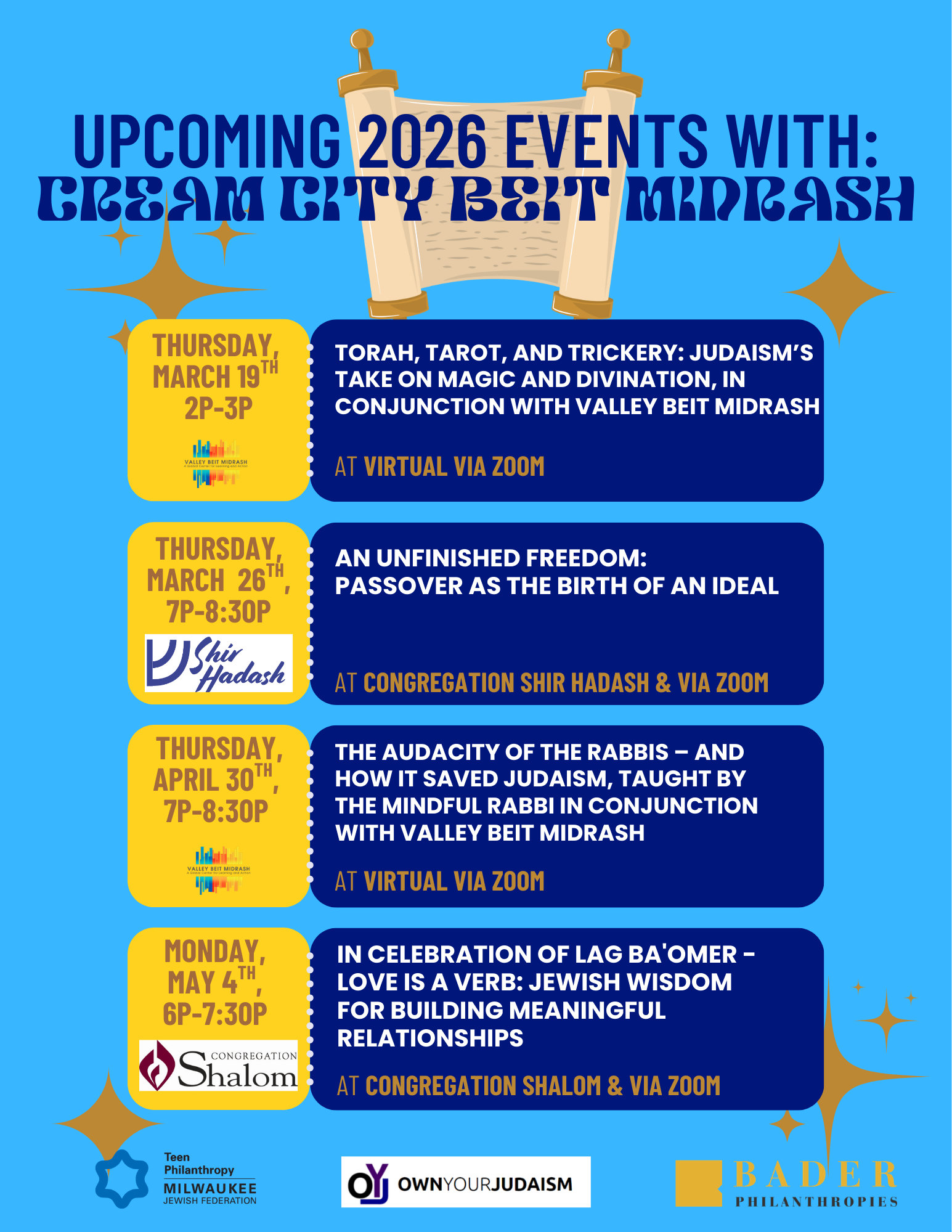
The rabbis once made a bold, audacious choice that changed the course of Jewish history and saved Judaism. In this class, we’ll trace that pivotal moment and discover how their courage and ingenuity can still guide and inspire us today. This Beit Madrash is presented by Valley Beit Midrash and taught by our own Moishe Steigmann, The Mindful Rabbi. This is a virtual learning session available on Zoom. To register, please follow this link!

Cream City Beit Midrash: An Unfinished Freedom: Passover As The Birth Of An Ideal

A hybrid event presentation (in-person & virtual) by Rabbi Dr. Armin Langer and Rabbi Moishe Steigmann

EVENT CO-HOSTED BY: Congregation Shir Hadash

ABOUT THE EVENT:

This year, we explore what freedom meant for the Israelites, who was included—and who was left out—in the Torah’s vision of liberation. We’ll reflect on how the call for freedom is both aspirational and incomplete and consider how its message resonates today. Together, we’ll imagine ways to carry forward the radical, unfinished work of freedom in our own lives and communities. This session will be co-taught by Rabbi Dr. Armin Langer of Congregation Shir Hadash, and Own Your Judaism’s Moishe Steigmann, The Mindful Rabbi.

ABOUT THE SPEAKERS:

Rabbi Dr. Armin Langer serves Shir Hadash as a teacher and community builder, committed to creating a welcoming, intellectually curious, and spiritually grounded Jewish home. Born in Germany to a family of Hungarian immigrants, he brings a deep awareness of Jewish diversity, memory, and resilience to his rabbinate. Before moving to Milwaukee, he taught and led prayer in diverse Jewish communities across Europe, the United States, and Mexico. Ordained by the Reconstructionist Rabbinical College, he holds a PhD in Sociology from Humboldt University of Berlin. His writing appears in academic journals and public-facing outlets including The Forward, Evolve, and The Conversation. He believes in a big-tent Judaism that brings Jewish tradition into conversation with contemporary ethical and social challenges.

Moishe Steigmann, The Mindful Rabbi, is the founder and director of Own Your Judaism and is the director of Ohel Ayalah. He seamlessly blends ancient Jewish wisdom with contemporary mindfulness practices. Through his teachings, writings, and workshops, he continues to influence and lead the conversation on mindful living within and beyond the Jewish community. He also speaks, hosts livestream conversations, and offers Jewish Life Coaching and organizational consultation. Born and raised in Milwaukee, Rabbi Steigmann is a proud father of two children, loves sports, is passionate about living gratefully, and enjoys almost all puzzles and games.

Thursday, March 26, 7:00pm – 8:30pm. The in person event includes a dessert reception following the Beit Midrash.

Event Registration Link

Valley Beit Midrash, Co-presented by Cream City Beit Midrash: Torah, Tarot, and Trickery: Judaism’s Take on Magic and Divination

ABOUT THE EVENT:

What does Judaism REALLY believe about magic and divination? Join Steven Gotlib, an experienced magician/mentalist and former Tarot-reader, to delve into this fascinating and under-appreciated topic. 

ABOUT THE SPEAKER:

Steven Gotlib is the Associate Rabbi at Mekor Habracha/Center City Synagogue and Director of the Center City Beit Midrash in Philadelphia, Pennsylvania. 

Thursday, March 19th, 2:00pm – 3:00pm Central Time

Event Registration Link

MINDFUL MESSAGE: Small Acts, Still Sacred

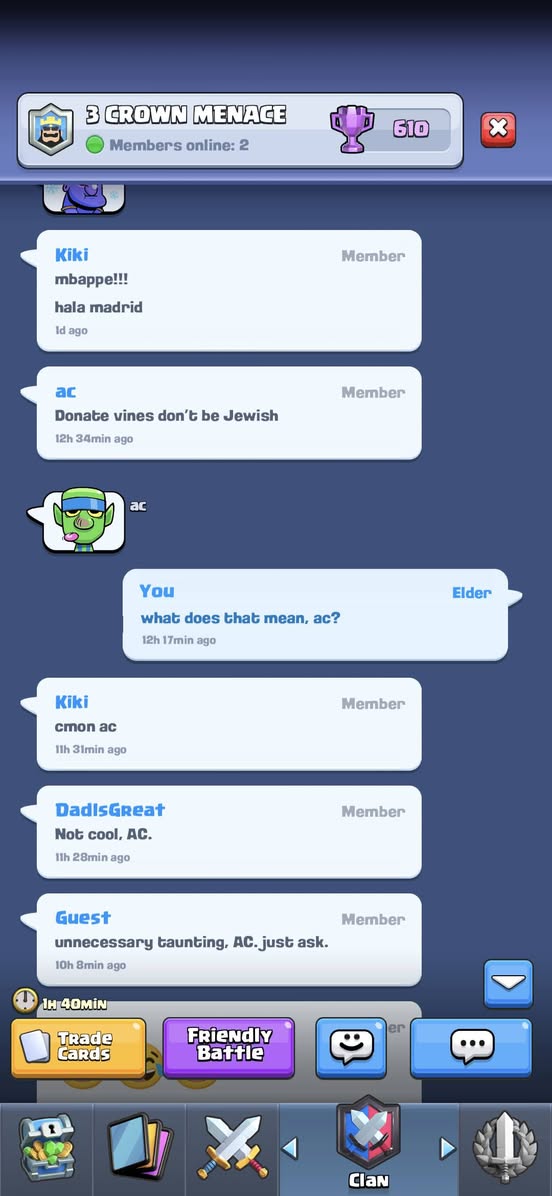
I play Clash Royale, a game on my phone, and I’m part of a clan where people can request card donations to make their deck stronger. Recently, someone asked for Vines and added the message:

“Donate vines, don’t be Jewish.”

I was the first to see it and simply asked, “What does that mean?”

Within moments, others chimed in—not with jokes or pile-ons, but with boundaries:

“C’mon, man.”

“Not cool.”

“Unnecessary taunting.”

“You can be funny without saying that.”

We’re living in turbulent times, from mass violence in Australia to horrifying murders in Minneapolis. It can feel like the world has lost its moral compass. And yet, it’s moments like these that reinforce for me that most people are, at their core, decent.

In an anonymous online game, among strangers of every background, someone said something derogatory, and others spoke up. Quietly. Immediately. Without being asked.

Small acts of allyship.

Small acts of resistance.

All anonymous.

All sincere.

Mindful action doesn’t always look like silence or stillness. Sometimes it’s saying, “Hey, that’s not okay,” and then moving on with kindness and integrity intact.

May small acts of courage continue to ripple far beyond where they begin.

MINDFUL MESSAGE: Faith & Wealth

On Tuesday, January 20, 2026, I had the joy and honor of sharing Judaism’s perspectives on Faith & Wealth during a Zoom Webinar hosted by the Interfaith Conference of Greater Milwaukee. Here is what I shared (and, If you would prefer to listen to what I shared, please follow this link to the 7 minute and 45 second audio file):

“Thank you, Ahmed. Thank you also to everyone for the opportunity and the honor to be here and to share a little bit about the Jewish teachings and perspectives about wealth. My name is Moishe Steigmann, The Mindful Rabbi, and once again, it’s really an honor to be here.

In Judaism, wealth is not simply an economic category. It’s not simply about how much money I have, how much money I can get. Wealth is also a spiritual category. Judaism does not ask whether wealth is good or bad. Rather, Judaism asks, “What does wealth do to us? And in turn, what does wealth ask us to do for others?” So, wealth really is not neutral. It’s not even self-justifying. Rather, wealth is a test of values and a test of awareness. 

Truthfully, wealth itself is not considered a problem within Judaism. The Torah, in fact, recognizes material prosperity as a blessing. Every single day, we, as Jews, recite the amidah, which is the central prayer and Judaism, and one of those prayers asks for prosperity. We bless each other, we bless ourselves with abundance and with wealth. 

At the same time, Judaism does warn about what abundance can do to us as individuals and, in turn, the harmful effects that can have for society. First of all, we can forget vulnerability. We can get comfortable with the wealth that we have, the lives that we live, and forget those in our society who are in need of help. We can forget interdependence, that wealth is not achieved alone. We live in an interdependent world, and anything that I have gained is really also on the footsteps of so, so, so many others, both visible and often unseen. And we can forget God, community, and responsibility. Throughout the Torah, we are taught of our responsibility to give to others, to leave what we have for others. 

Instead, we grow attached to our wealth. Like in Islam, as Ahmed is suggesting, ownership in Judaism is conditional. Things do not belong to us and to us alone. Rather, we are taught that everything in the earth is the Lord’s. We are not absolute owners of anything. Rather, we are stewards. And yes, possession might be real in a tangible sense, and it is never ultimate. Judaism insists that even what I earn is not mine alone because no one earns in isolation. For instance, every single time after we eat food, in our grace after meals, we bless God, and we bless the land. I don’t have food just because I have money. I have food because of God and because of the land. We recognize that labor depends on society; markets depend on trust; success depends on randomness as much as effort. 

Wealth is something that we hold. It’s not something that we are. It’s not, “I am wealthy.” Rather, it’s, “I have wealth.” It’s not, “what did I do to deserve my wealth?” It’s, “what do I do with the wealth with which I am blessed?” 

The most common name to Jewish giving is tzedakah, and many of you may have heard that before. We often simplify and often mistranslate tzedakah as charity. Tzedakah is not the impulse to want to do something kind for someone else and to give them money. Rather, tzedakah comes from the Hebrew root word of tzedek, which is justice. Tzedakah is a societal, collective, and individual obligation.

Maimonides–Rambam–a 12th century Jewish theologian and scholar, talks beautifully about the hierarchy of tzedakah, and that tzedaha, the point is really to center dignity. Because one of the highest levels of tzedakah is giving and receiving anonymously, so no one is embarrassed in front of their fellow. And the highest level of tzedakah is helping someone find a job. Maimonides also reinforces the Jewish notion of tithing, giving 10 percent of one’s income. And fascinatingly. he also says that a Jew should not give more than 20 percent of their income. His justification is, lest they become impoverished themselves. Which, 800 years ago, makes sense. Maybe I give so much that I, in turn, become one who is needy. I can’t imagine, however, that maimonides could imagine, can understand the incomprehensible individual wealth that exists today. And so I think Judaism rather is focused on the core principles of sustainability and responsibility.

The question that Judaism forces us to ask today is whether ethical responsibility has scaled along with capacity. Judaism invites us to hold wealth with awareness rather than with anxiety, with gratitude rather than guilt, and with responsibility rather than entitlement. 

Indeed, I suspect–and I am so excited to hear whether my suspicion is accurate or misses the mark–I suspect that every faith represented here asks some version of the same question: “How do we live ethically and remain fully human in the presence of abundance?” And I wonder out of curiosity and mindful reflection, “What would change if we measured success not by what we accumulate rather by how awake we remain in the presence of abundance?”

And so it is my hope and blessing for each one of us that we are indeed prosperous. And that, in turn, we use our prosperity to embody the ideals, values, teachings, and traditions of each of our faith practices to our individual and collective responsibility to truly make the world a better and more just place.

Thank you.”

MINDFUL MESSAGE: Two Decades Later

Twenty years ago, during my final year of rabbinical school, I delivered this sermon to the community. Each graduating rabbi was invited to offer reflections, and I remember how nervous I felt standing at the pulpit, sharing words that were still very much in formation.

Two decades later, I read them with a different kind of awareness. While my labels have shifted—I no longer think of myself as a “Conservative rabbi,” just a rabbi—the questions I wrestled with then about God, relationship, belonging, and Judaism still accompany me. What has changed is not the presence of doubt, but my capacity to sit with it more gently, more honestly, and with greater compassion for myself and others.

I share these words now as a mindful reflection on growth over time—how we evolve without outgrowing our questions, and how the seeds planted years ago continue to teach us who we are becoming.

As you read, consider: What beliefs, questions, or uncertainties from an earlier chapter of your life are still with you today? In what ways have you grown—not necessarily by resolving them, but by learning to live with them more wisely?

Shabbat shalom.

Top