MINDFUL MESSAGE: The Beautiful Exhaustion of a Cherished Life

Last week brought two watershed moments in my life: the launch of my book, ‘Your Jewish Journey’, and the Milwaukee Brewers winning the World Series.

Both kept me up late at night. Both demanded a tremendous amount of time and energy. Both left me exhausted. And I wouldn’t change a thing.

Thursday was particularly chaotic. My book went live on Amazon, I was reaching out to people about our upcoming book launch, and I was grateful for all the people who took the time to reach out and celebrate with me.

At the same time, I was still giddy about the Brewers. I was coordinating with my wife and kids, separately and together, trying to figure out how we could all get to the parade early Friday morning. My wife would be coming from home, my daughter from her mom’s, and my son from Madison, where he’s a freshman in college. There were countless texts, conversations, logistics, and moving pieces.

And, of course, I had an important deadline: 7:15 p.m., when the Packers game started. Unfortuately, that didn’t happen: I was still finishing things up midway through the third quarter.

By any conventional measure, it was a tiring, chaotic, and exhausting day. And yet, when I look back, I wouldn’t trade a minute of it.

We spend a lot of time talking about the importance of rest, balance, and knowing when to slow down. Those things matter. But perhaps there’s another kind of exhaustion worth recognizing: the kind that comes from doing things we love, celebrating moments we’ve worked toward, and making memories with the people who matter most.

Sometimes, life is wonderfully exhausting.

And perhaps one measure of a meaningful life isn’t how little we’re exhausted but whether some of the things that exhaust us are also the things we’re most grateful to have experienced.

I’ll take a little less sleep and a lot more of these moments.

MINDFUL MESSAGE: The Lessons We Learn from Children

The morning after returning from New York, where I had led Yom Kippur services, I was exhausted. Still, I eagerly got up at 6:15 a.m. to visit Salam School, a private Islamic K–12 school, where I had been invited to speak with a high school world religions class about Judaism.

For an hour, these students asked thoughtful, insightful questions about Jewish life. They wanted to understand everything from broad Jewish themes to the minutiae of Jewish law and practice to the realities of being Jewish in America today. Their curiosity opened the door to a rich conversation about Judaism and Islam, exploring the traditions we share, the ways we differ, and what we can learn from one another.

What struck me most was the students themselves. They were joyful, curious, and genuinely interested in understanding a tradition and a community beyond their own experience.

In a world filled with so much hatred and discord, particularly between Jewish and Muslim communities, there is something profoundly moving about teenagers approaching someone from another faith with such openness. They weren’t interested in arguments or assumptions. They wanted to learn.

Hatred is learned. So is curiosity. So is openness. So is the ability to see someone whose life and traditions are different from our own and approach them with genuine interest.

Perhaps one of the most important things we can do for the next generation is to nurture that curiosity. And perhaps one of the most important things they can do for us is remind us why it matters.

May we learn from these students to approach people we don’t yet understand with curiosity rather than assumptions about who they are.

MINDFUL MESSAGE: MAKE TIME FOR WHAT BRINGS US JOY

In this week’s Torah portion, Ki Teitzei, we encounter a rather unusual commandment: When a man gets married, he is exempt from military service for an entire year. The Torah explains that this time is set aside so that he can “bring joy to his wife.”

In modern language, I might understand this as a reminder that when we enter a new marriage or partnership, we should make time to delight in the person we love and in the life we are building together. There are always other things calling for our attention. The Torah tells us that, sometimes, the joy we create together deserves to take priority.

As someone who got married less than two weeks ago, this commandment has taken on new meaning for me. Shara and I had already been together for six years, yet somehow marriage feels different. I find myself feeling the absence of her more acutely when we’re apart. I want to spend time together. I want to make her happy. I want to celebrate this new chapter with her.

And it has gotten me thinking about the way we prioritize our lives.

We all have obligations. Work needs to get done. Errands need to be run. Emails need to be answered. There are always responsibilities waiting for us. And many of them are important. Yet sometimes the things that demand our attention most urgently can crowd out the things that give our lives the greatest sense of joy, grounding, contentment, and fulfillment.

We tell ourselves we’ll make time for those things later. Later, when work slows down. Later, when the kids are older. Later, when the house is in order. Later, when we have fewer things on our plate.

But what if “later” keeps getting pushed further away?

As we enter the month of Elul and begin preparing for the High Holidays, perhaps this is a moment to reconsider what deserves our time and attention. The work of these weeks is not simply to examine what we’ve done wrong or what we need to change. It is also an opportunity to remember what we treasure and ask whether our lives reflect those priorities.

My wedding blessing for all of us this season is that we make time for what brings us joy. That we give ourselves permission to delight in the people we love, to celebrate the relationships that sustain us, and to make space for the experiences that ground and fulfill us.

MINDFUL MESSAGE: SURPRISE!

Facebook reminded me of this memory from two years ago, when I was eating a peach and discovered something I had never seen before. The pit had split open, revealing the seed inside. It looked exactly like an almond! Thankfully, I didn’t test it out by eating it right away…

I learned that the seed inside a peach pit contains compounds that can be poisonous if eaten. What appears nourishing on the surface is actually something to avoid.

Seeing that picture again, I wonder: How often is that true in our own lives?

Not everything that looks good is good for us. Some habits promise comfort but leave us emptier. Some opportunities sparkle but pull us away from who we want to be. Some words, relationships, or distractions seem harmless until we realize the cost they carry. That mindful pause first, though, asks us to slow down long enough to discern what is truly life-giving.

The peach also offers another lesson. The pit had to crack open for me to see what was hidden inside. Sometimes our own lives crack open as well. Those moments can reveal both gifts and dangers, wisdom and temptation. Growth isn’t simply about discovering what’s within us. It’s also about learning what to embrace and what to leave behind.

May today be full of surprises, and we consider mindfully which to embrace in our lives and how to do so in a healthy way.

MINDFUL MESSAGE: The Unseen Beauty Within

This week, while making dinner, my fiance cut open a head of bok choy and discovered something unexpected: a tiny yellow flower nestled deep inside the leaves.

It made me wonder how much beauty we miss simply because we stop looking after the first layer.

We often search for meaning in dramatic moments, extraordinary experiences, or faraway places. And life has a way of hiding many of its greatest gifts inside the ordinary: a conversation, a quiet walk, a familiar ritual… even a vegetable.

I believe that’s true of people, too, including each of us. Beneath our routines, our worries, and the stories we tell about who we are, something beautiful is already growing. Mindful focus doesn’t create that beauty; it simply helps us notice it.

Sometimes the most remarkable discoveries aren’t found by searching harder. They’re found by paying closer attention.

MINDFUL MESSAGE: Tangled at Take-Off

For four years now, a bird has built her nest on the eave of my front porch. I’ve come to love this annual rhythm: watching a mother raise her young until they eventually fly away.

Recently, I found myself singing oof gozal in my head, the Israeli song about a young bird leaving the nest and the complicated emotions that come with parents letting go. I knew the time was coming.

In the meantime, I had developed my own little practice of using the front door as sparingly as possible. Whenever I came and went, the mother bird would startle, fly to the tree in my yard, and chirp frantically until things settled again. Though I still made occasional exceptions for baby-bird photo shoots.

This morning, I was getting ready for a Zoom meeting when my mailwoman dropped off the mail. The mother bird immediately started chirping, but something felt different.

The mailwoman looked from the tree to the nest and back again. I first assumed she was trying to spot the babies. Then I noticed her expression.

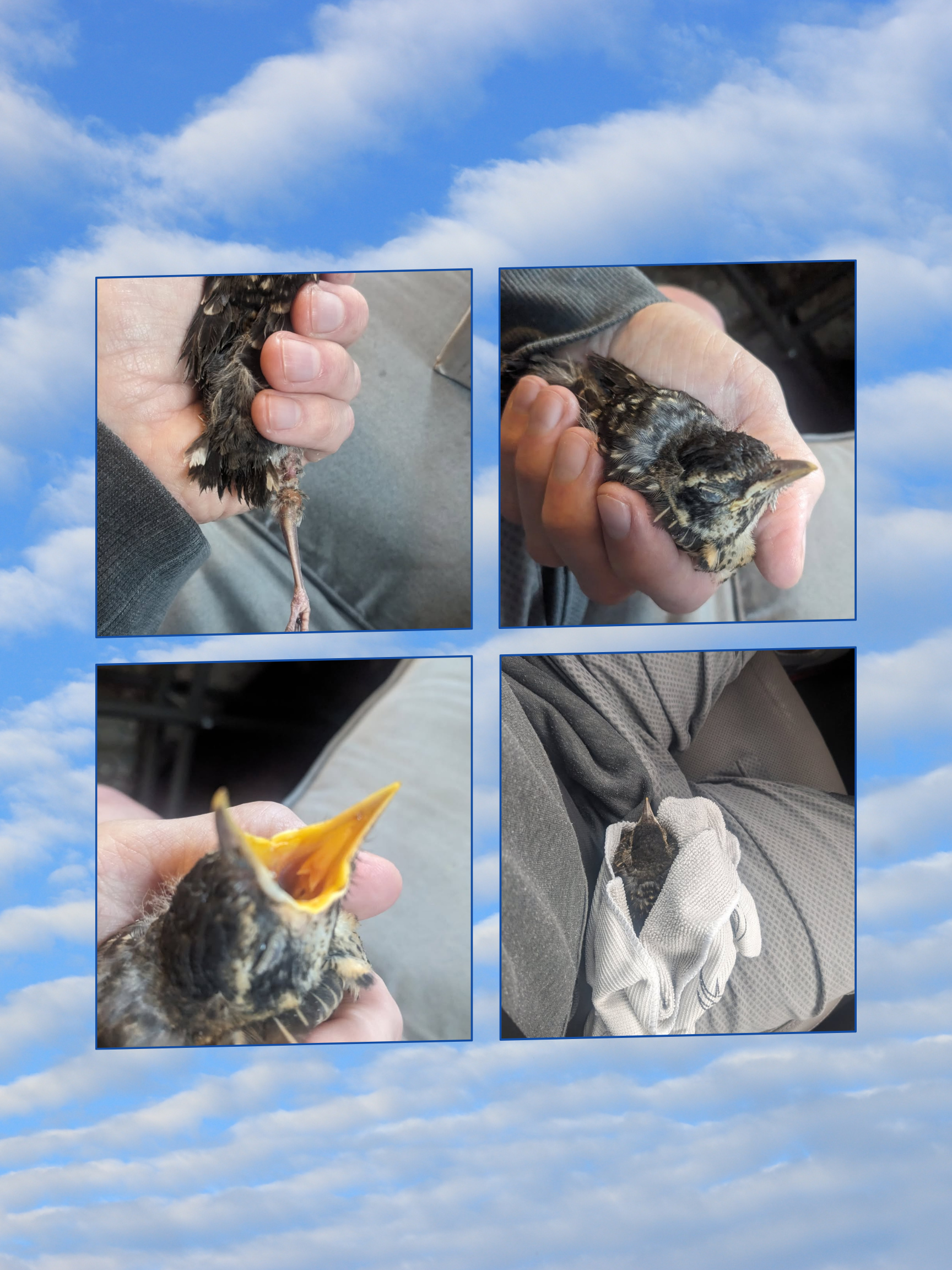
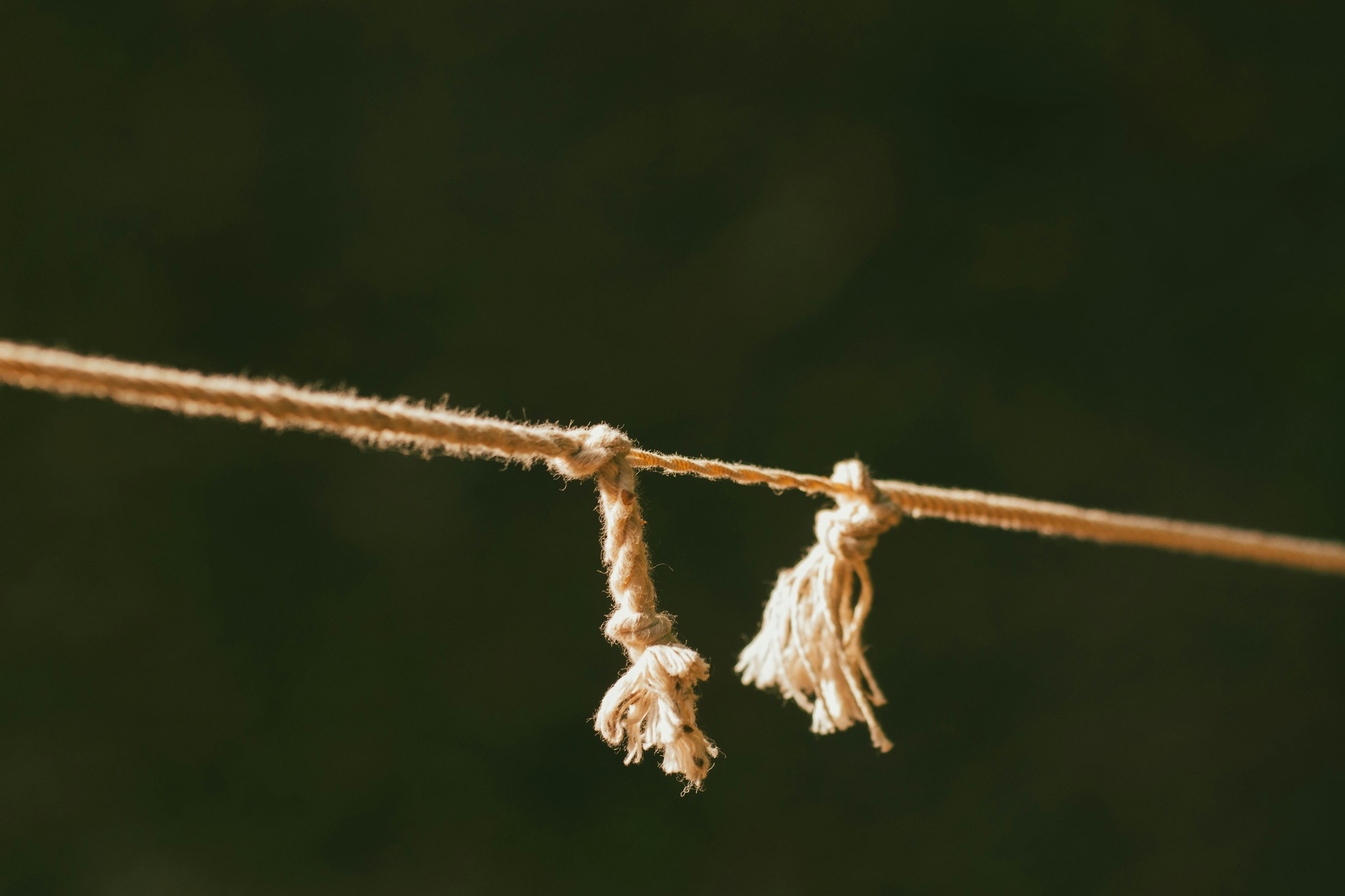
One of the baby birds had become tangled outside of the nest and was hanging upside down by a leg caught in a piece of straw. After some careful work, I untangled the leg with help from the mailwoman.

But something still wasn’t right: the bird couldn’t bend the leg.

I carried the tiny bird inside and held it in my hand while I called the Humane Society. It chirped anxiously the whole time until it finally stopped, settled down, and fell asleep in my hand while I gently rubbed its head. I wrapped it in a towel and brought it in.

When I returned home, I thought I might somehow explain to the mother bird what had happened to her baby. Instead, I found an empty nest.

The others had flown. Oof gozal.

Maybe they had already been ready. Maybe this one got caught in the very moment it was trying to leave.

Truthfully, I’m not entirely sure what the message is here. And I do wonder whether many of us know what it feels like to get tangled sometimes—to get caught up, held back, or left behind while everyone else seems to be flying onward.

And if there is a prayer hidden in all of this, perhaps it is this:

May we have people in our lives who help untangle us when we cannot free ourselves.

May we know how to offer that same hand to others.

And when the time comes, may we all find our way back to flight.

MINDFUL MESSAGE: Why I Love Israel, Why I Feel Disconnected From Israel

Moishe Steigmann, The Mindful Rabbi, our Executive Director and Rabbi, recently shared a personal reflection on his evolving relationship with Israel, Jewish identity, and spiritual belonging. We are sharing it here in the spirit of thoughtful, compassionate, and honest engagement with complex questions facing Jewish life today.

_______________________________________________________________________________________________________

There are certain topics that live so close to the soul that speaking about them publicly feels almost like a betrayal of community and intimacy.

For a long time, I have struggled to articulate my relationship with Israel because my feelings toward it refuse to flatten into slogans. I do not fit neatly into the categories that increasingly dominate Jewish and political discourse. I cannot speak about Israel as though it is merely an abstract geopolitical entity. Nor can I ignore the profound moral, spiritual, and emotional dissonance I increasingly feel.

And so, I write this not as an expert, not as a historian, not as someone claiming definitive truth, but as a Jew, a rabbi, and a human being trying to honestly describe an internal rupture.

These reflections are personal. They are emotional. They are incomplete. They may contain factual misunderstandings or imperfect framing, and I welcome correction where appropriate. My goal here is not to persuade anyone, but to speak openly about my experience, one I suspect many others quietly carry as well.

THE ISRAEL I LOVED
Before Israel was an argument, it was a feeling.

It was memory.
Longing.
Family.
Story.
Language.
Peoplehood.

My first trip to Israel was the summer before I turned 10. I still recall my deep despondence on the final night of my trip. More than anything else that night, after saying goodbye to my family, I simply wanted to see the Kotel one more time. My mom explained that the sheirut (shared taxi) we were taking to the airport had a defined route picking up people at various locations. It could not detour, even for one final fleeting glance at the Kotel.

I remember crying. I could not explain then—and I certainly cannot explain now—why I felt such longing and attachment to the Wall that night. Yet the emotion was real.

And somehow, impossibly, my final wish came true. One of the passengers in the sheirut had a pick-up right near the Kotel. And my emotional connection with Israel was completed at that moment.

That moment mattered deeply to me. Not politically. Spiritually.

Israel was never simply “a country” to me. It was woven into my understanding of Jewish existence itself. My family lives there. My memories live there. My community lives there. Parts of my identity were shaped there.

Even writing these reflections now is, in its own strange way, an expression of love. We do not grieve disconnection from things that mean nothing to us.

WHEN BELONGING BECOME CONDITIONAL
Over time, however, the relationship became more complicated. There emerged a growing accumulation of moments where something inside me no longer aligned.

One of the deepest examples of this for me is the Kotel itself. The place that once symbolized spiritual belonging increasingly came to symbolize exclusion. As an egalitarian Jew, I was not allowed to pray with my community at the Wall itself; we were relegated to a separate section at Robinson’s Arch.

The Kotel thus became, for me, not a holy site, but rather a symbol of a deeper rupture within Jewish life: the growing sense that Jewish belonging itself was becoming conditional. I wrote a reflection on that nearly ten years ago (https://ownyourjudaism.org/no-longer-my-spiritual-home/).
What once felt like a shared inheritance began to feel conditional: You belong… but only if you belong correctly.

And that pain is difficult to explain to people who experience Judaism differently. Because for many Diaspora Jews—especially non-Orthodox Jews—Israel is spoken about as our homeland while many of our forms of Jewish practice remain institutionally marginalized, delegitimized, or rejected there.

Now, as I write this, there is legislation before the Knesset seeking to criminalize non-Orthodox prayer at the Kotel itself (https://www.timesofisrael.com/divisive-bill-barring-non…/). Whether or not such proposals ultimately become law, the symbolism is impossible for me to ignore. The place that once represented my deepest feelings of Jewish connection increasingly feels like a place where my Judaism itself is suspect.

Over time, I began realizing that this feeling extended beyond the Kotel.

Part of what I increasingly struggle with is what happens when Jewish belonging becomes narrowed by ideological and religious gatekeeping, when there emerges an increasingly rigid definition not only of “authentic Judaism” but of legitimate Jewish moral and political identity itself.

I began noticing this narrowing in religious spaces. Then in political discourse. Then in conversations around nationalism, dissent, Palestinians, democracy, and power.

The dissonance became harder to ignore.

MORAL DISSONANCE
The rupture, however, is not only religious. It is also moral.

There are realities connected to Gaza, the West Bank, settler violence, unequal treatment under law, and nationalist rhetoric that increasingly trouble me deeply.

Part of what makes this so painful is that my concerns do not emerge from distance from Jewish history, but from closeness to it.

I understand the fears Israelis carry.
I understand Jewish vulnerability.
I understand trauma.
I understand why security matters.

And yet I also find myself struggling with what happens when fear hardens into moral numbness or when nationalism begins overriding ethical consistency.

One of the things I find hardest to reconcile is the difference in communal reaction to violence depending on who commits it, where Israelis and Palestinians who throw rocks, for instance, often face profoundly different consequences and public narratives (https://www.timesofisrael.com/top-idf-officer-admits…/).

I struggle as well with rhetoric from public figures that I experience as deeply dehumanizing toward Palestinians and that call forward a conquest of all land that was ever in Jewish control alongside what often feels to me like insufficient communal outrage in response. Perhaps what troubles me most is not simply the existence of extremist rhetoric (every society has extremists) but how easily such rhetoric can become normalized when wrapped in the language of nationalism, security, or Jewish survival.

I say this cautiously because I know how emotionally charged these conversations are. I know there are contexts I may not fully understand. I know Israelis live with realities I do not experience daily.

But moral discomfort does not disappear simply because complexity exists.

NATIONALISM AND JEWISH IDENTITY
Part of the deeper tension may be philosophical.

At my core, I am profoundly wary of nationalism whenever it begins eclipsing universal ethical obligation, human dignity, or moral self-critique.

And increasingly, I experience Israel not as a homeland and haven for Jews, but as a deeply nationalist society.

That realization creates a painful tension within me because I do not experience my Judaism primarily through nationalism. I experience it through ethics, spirituality, memory, learning, wrestling, compassion, questioning, and covenantal responsibility.

SPIRITUAL HOMELESSNESS
What I struggle with most is not political disagreement.

It is spiritual homelessness.

How do you remain emotionally connected to a place that increasingly makes parts of your Jewish identity feel unwelcome?
How do you maintain attachment while experiencing alienation?
How do you criticize without severing connection?
How do you stay morally honest without collapsing into cynicism?
How do you love something that hurts you?

I do not yet have answers to these questions.

What I do know is that pretending the tension does not exist no longer feels spiritually sustainable for me.

WHAT I AM NOT SAYING
I am not saying Israel should not exist.
I am not denying Jewish history or vulnerability.
I am not claiming moral purity.
I am not pretending these issues are simple.
I am not ignoring antisemitism, terrorism, or the impossible realities Israelis face, especially in the aftermath of the atrocities of October 7th.

And I am certainly not placing myself outside the Jewish story.

If anything, this reflection emerges because I feel too inside it.

WHY SPEAK NOW
For a long time, I hesitated to say any of this publicly.

Partly out of fear:
fear of being misunderstood,
fear of hurting people I love,
fear of being weaponized by those acting in bad faith,
fear of alienating community,
fear of becoming reducible to a “position”.

But silence also carries a cost.

And perhaps part of mature Jewish identity is learning how to remain in a relationship even amid profound discomfort and disagreement.

I do not know where my relationship with Israel goes from here.

What I know is this:
I still love Israel.
I still ache for it.
I still feel bound to it.
And I still deeply love my family who live there, and I long to visit them in Jerusalem again.

And increasingly, I no longer know what to do with that love.

MINDFUL MESSAGE: The Giving Birthday

There is something quietly sacred about giving not out of obligation but rather out of love.

A friend recently chose to celebrate her birthday not with gifts or attention, but by offering her professional talents pro bono to a nonprofit children’s center that has deeply touched her life. In a culture that often teaches us to ask, “What do I want for my birthday?”, she asked a different question altogether: “What can I give?”

Judaism reminds us that generosity is measured by more than dollars. It is also measured by presence, intention, and heart. It is about what part of ourselves we are willing to place in service of something larger.

A mindful reflection:

*What gifts or talents have I developed that could ease someone else’s burden?

*Where in my life am I being invited to give more personally, not just materially?

*What would it mean to turn celebration itself into an act of generosity?

In Pirkei Avot, we are taught: “The world stands on Torah, on service, and on acts of lovingkindness.” Sometimes, lovingkindness looks less like grand gestures and more like quietly showing up with what only you can offer.

MINDFUL MESSAGE: WHO IS WISE?

“Eizehu chacham?” Pirkei Avot asks. “Who is wise?”

“Ha-lomed mikol adam (the one who learns from everyone).”

I never imagined I’d see this teaching come to life at a poker table.

Recently, when I was playing, the conversation turned to deceit—not bluffing, but real dishonesty. People began sharing personal stories and reflections, exploring the roles of lying and enabling.

In a pause, I offered a quote: “It takes two to lie: one to lie, and one to listen.”

The dealer stopped, looked up, and said, “That’s life-changing.” He asked who said it.

He took a guess. “Gandhi?” Nope.

“MLK?” someone suggested. Nope.

“Mother Teresa?” Not this time either.

It turned into a full-on guessing game, eventually even 20 questions. After several minutes (and definitely more than twenty questions), someone finally landed on the answer.

Not a saint. Not a prophet.

Homer.

And not the poet but rather Homer Simpson.

And maybe that’s the deeper point.

Sometimes a line sounds profound enough that we instinctively attribute it to the most morally courageous voices we know. But wisdom doesn’t always arrive wrapped in moral authority. Sometimes it shows up in unlikely, even buffoonish places… and still asks something real of us.

“Eizehu chacham?” The one who learns from everyone.

MINDFUL MESSAGE: Who do you love most?

Seven years ago, my daughter asked me one of the most powerful questions I have ever heard. Indeed, loving myself has been one of my biggest challenges throughout my life, and it took me until my early 40s to truly find self-love. Leave it to a then 7-year-old to put it into beautiful perspective! I’d love to hear your responses to her question.

And, speaking of love, I hope you can join Rabbi Noah Chertkoff and me for our upcoming co-taught class, both in-person and by Zoom, centering on love.

__________________________________________________

“Do you love us more than you love yourself?”

As kids are wont to do, Yael asked me how much I love her and Matan. I told her, as parents often and honestly reply, “More than anything else.”

She then followed up by listing a series of people and things to confirm/test my response, and I honestly replied that I do indeed love her and Matan more than anything that she named.

She then asked a question (a couple of weeks ago, and she has followed up!) which has since fascinated me: “Do you love us more than you love yourself?”

I confess that I don’t have a great answer (and I told that to Yael). I really don’t! I’m asking with a smile and genuinely: how would you answer this question for yourself (not for your kids, but for yourself)?

I love this question…!