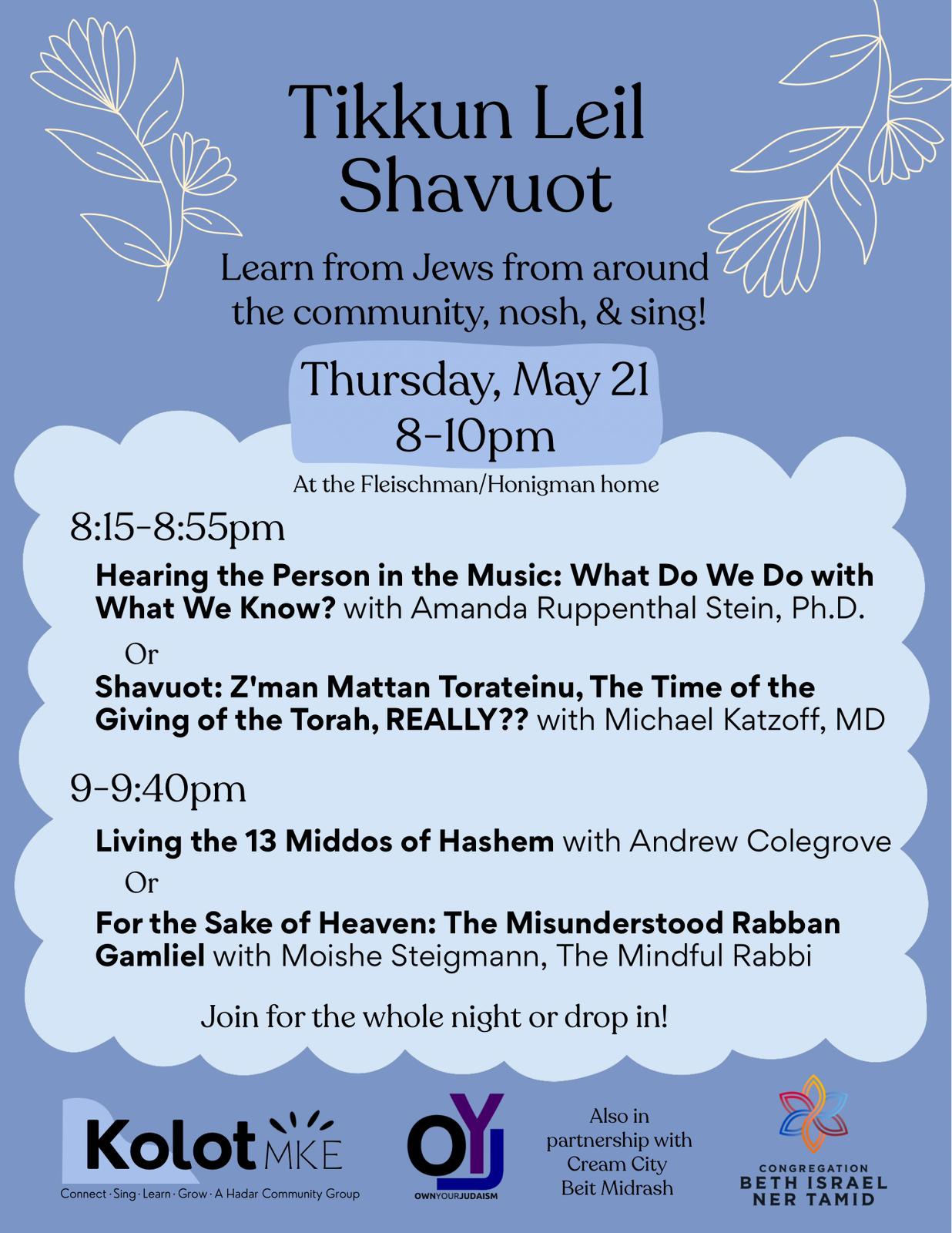
Tikkun Leil Shavout

Thursday, May 21, 8pm to 10pm

Tikkun Leil Shavuot is the Jewish tradition of studying Torah throughout the first night of Shavuot to prepare for receiving the Torah, which is commemorated the next morning.

Join Moishe Steigmann, The Mindful Rabbi, and others as we gather together to learn, nosh and sing! This event is generously hosted at the Fleischman / Honigman home (1852 W Brantwood Ct., Glendale, WI), and co-sponsored by KolotMKE, OYJ, Cream City Beit Midrash, and Congregation Beth Israel New Tamid.

JCRC Freedom Seder

Freedom Seder: Growing Stronger Together, a meaningful Passover experience inspired by the historic Freedom Seders that brought communities together in the shared pursuit of justice and liberation.

This powerful Seder connects the Jewish story of liberation with the broader struggle for civil rights. Through ritual and shared conversation, we will reflect on our shared pursuit of freedom and justice, coming together across communities and faiths.

This event is a collaborative effort of the Black Jewish Alliance of the JCRC, Bader Philanthropies, Congregation Shalom, and Tikkun Ha-Ir.

While this event is currently sold out, please email us if you would like to join the waitlist.

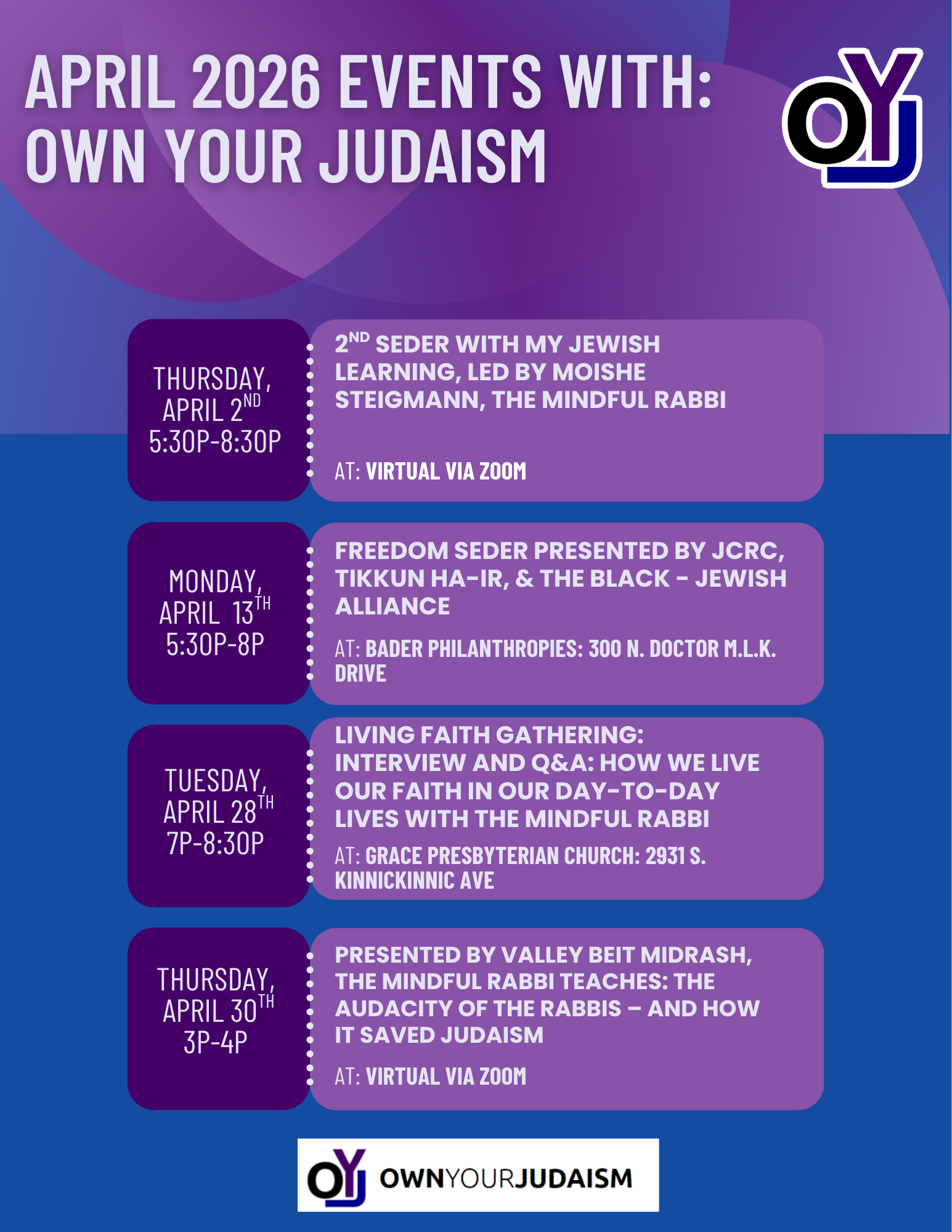
Upcoming April 2026 Events With OYJ

OYJ is proud to present and co-present these upcoming events and programs in April 2026:

On Thursday, April 2nd, join My Jewish Learning for the online Second Night Seder led by Moishe Steigmann, The Mindful Rabbi from 5:30pm to 8:30pm CDT.

Monday, April 13th brings us the Freedom Seder, presented by Tikkun Ha-Ir, The Black – Jewish Alliance of JCRC, Bader Philanthropies, and Congregation Shalom. Registration has closed, but you are welcome to email us to join the wait list if you wish.

Moishe Steigmann, The Mindful Rabbi, will be interviewed and participate in a live Q&A about how we live our faith in our day-to-day lives on Tuesday, April 28th from 7pm to 8:30pm at the Living Faith Gathering. This event is hosted at Grace Presbyterian Church (2931 S. Kinnickinnic Avenue). Walk-ins are welcome!

Our final program for the month of April is a virtual Zoom event presented by Valley Beit Midrash. The Mindful Rabbi will teach: The Audacity of Rabbis – and How It Saved Judaism. Registration for this learning event is available here.

Each opportunity for our community to celebrate, appreciate, and learn has its own event post, which in turn will direct you to the information or registration page. You may also follow the link in the post in each event’s name. OYJ looks forward to celebrating, learning, and building community with you!

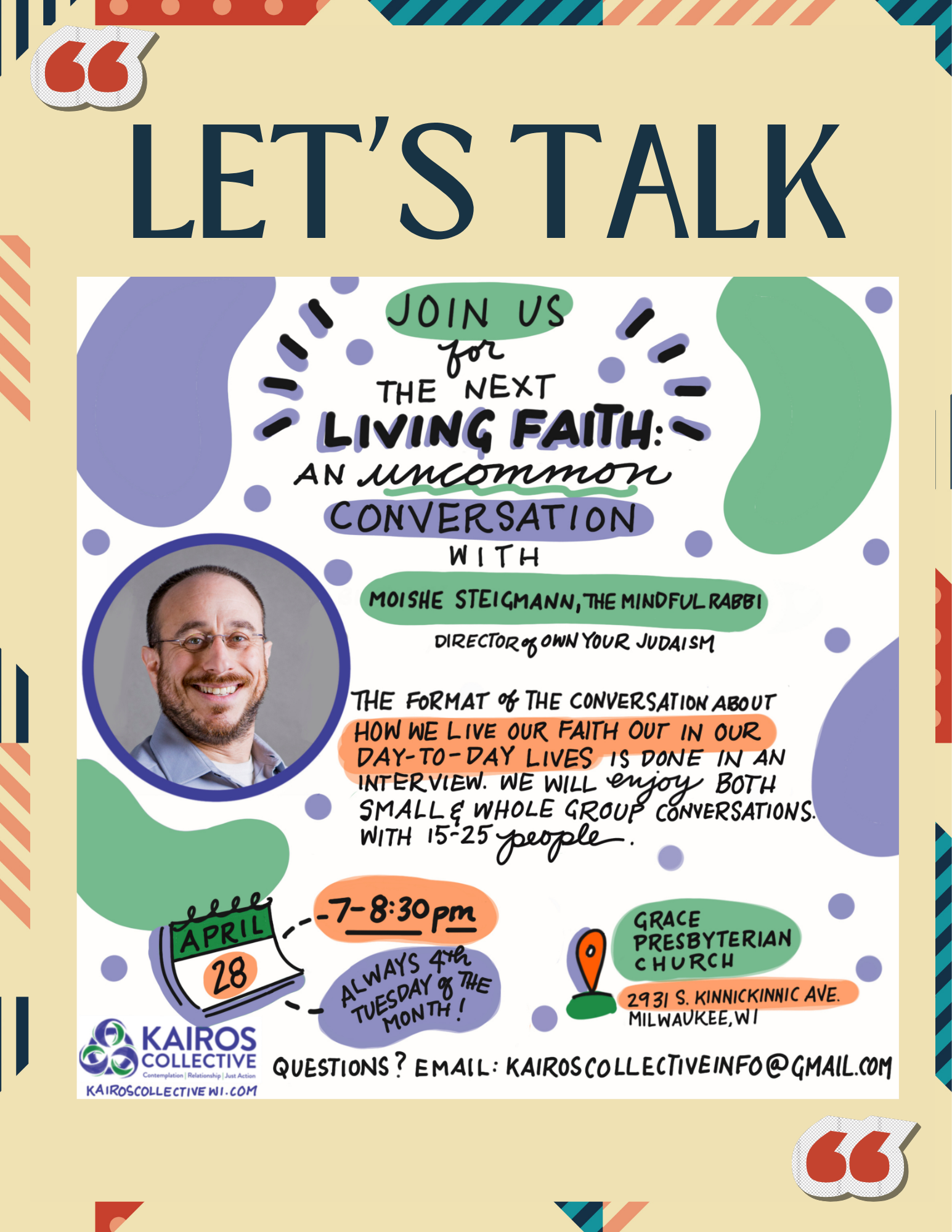
Living Faith: An Uncommon Conversation With Moishe Steigmann, The Mindful Rabbi

“An uncommon conversation with Moishe Steigmann, The Mindful Rabbi, Director of Own Your Judaism. The format of the conversation about how we live our faith in our day-to-day lives is done in an interview. We will enjoy both small and whole group conversations.”

Tuesday, April 28th, 7pm to 8:30pm CDT

Grace Presbyterian Church, 2931 S. Kinnickinnic Ave., Milwaukee, WI

Walk-in’s are welcome!

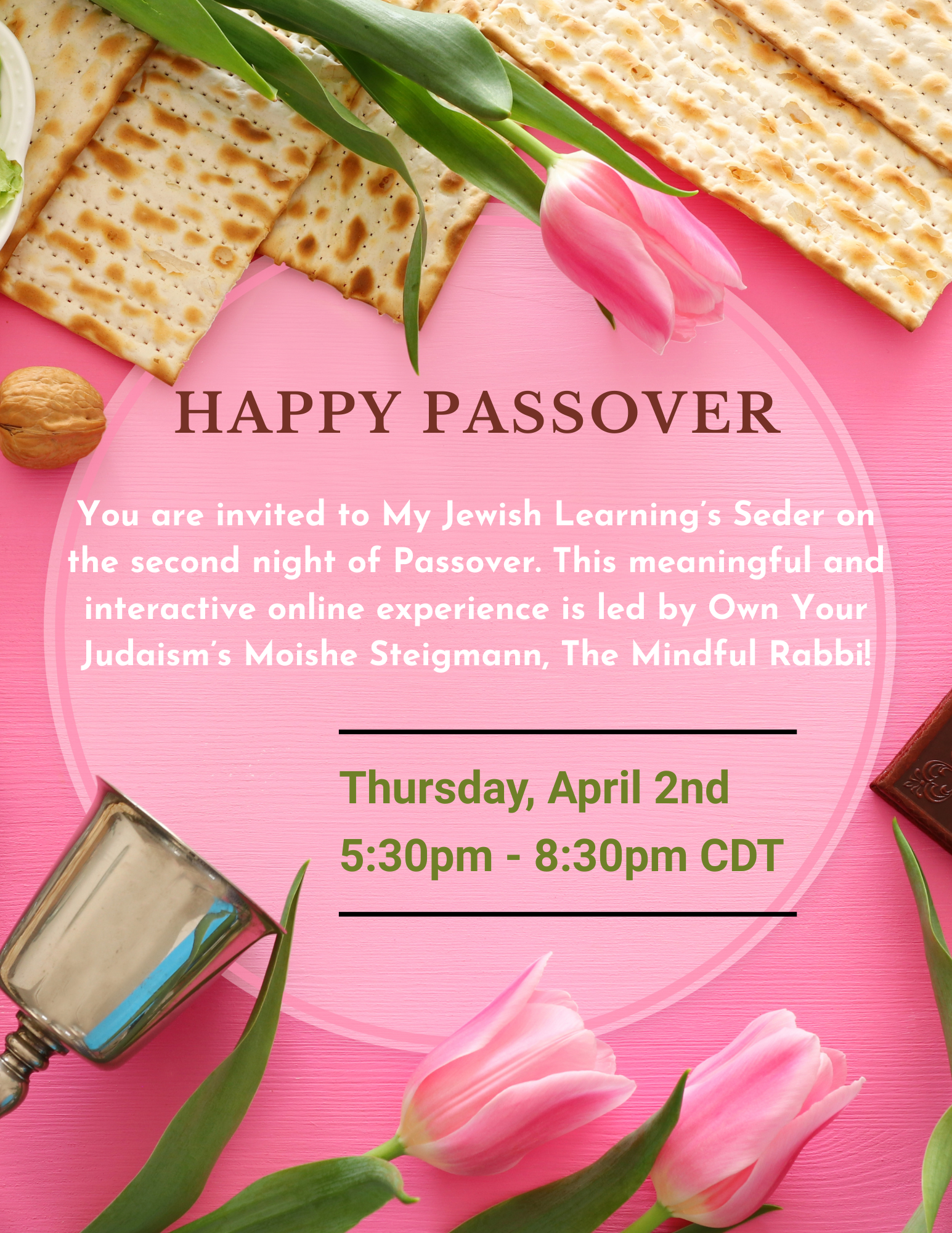
My Jewish Learning Second Night Passover Seder

Join us for a fun and interactive online Second Night Seder!

You’re invited to the My Jewish Learning Seder on the second night of Passover (Thursday, April 2nd from 4:30pm to 7:30pm CDT)!

Join us for a meaningful and interactive online experience filled with traditional prayers, songs, and the retelling of the Passover story. Connect with family and friends virtually as we commemorate this special occasion together.

Whether you’re continuing a long-standing tradition or exploring the Seder for the first time, all are welcome to participate in this joyous event. Register here!

About Our Seder Leader

Moishe Steigmann, The Mindful Rabbi, is the founder and director of Own Your Judaism. He also speaks, hosts livestream conversations, and offers Jewish Life Coaching and organizational consultation. An ordained rabbi with a masters in education, he has been the rabbi of two synagogues, one community Jewish day school, and one Jewish camp.

Mishloach Manot Making Workshop

Mishloach Manot brings together everything we hope Jewish experiences can be: easeful, joyful, and social. From assembling to distributing festive gift bags—and enjoying a few snacks along the way and taking home some swag—this tradition is rich with meaning. We’re proud to launch Milwaukee’s first community-wide Mishloach Manot Workshop, packaging and delivering 1,000 bags to those least likely to make them themselves: seniors, homebound individuals, and students across all Jewish schools. Best of all, this festive practice is open and accessible to everyone of all ages and backgrounds! We hope you, your family, and your friends can join us. Come for the whole 90 minutes or even stop by for just a few. 

This program was made possible by grants from the Lewis & Patricia Chamoy Family Donor Advised Fund of the Jewish Community Foundation of the Milwaukee Jewish
Federation and also the National Center for Encouraging Judaism. Additionally, we are grateful to the Harry & Rose SamsonFamily Jewish Community Center for hosting our workshop, as well as to Tikkun Ha-Ir for delivering our gift bags!

MINDFUL MESSAGE: Tu Bishvat Reflection Questions

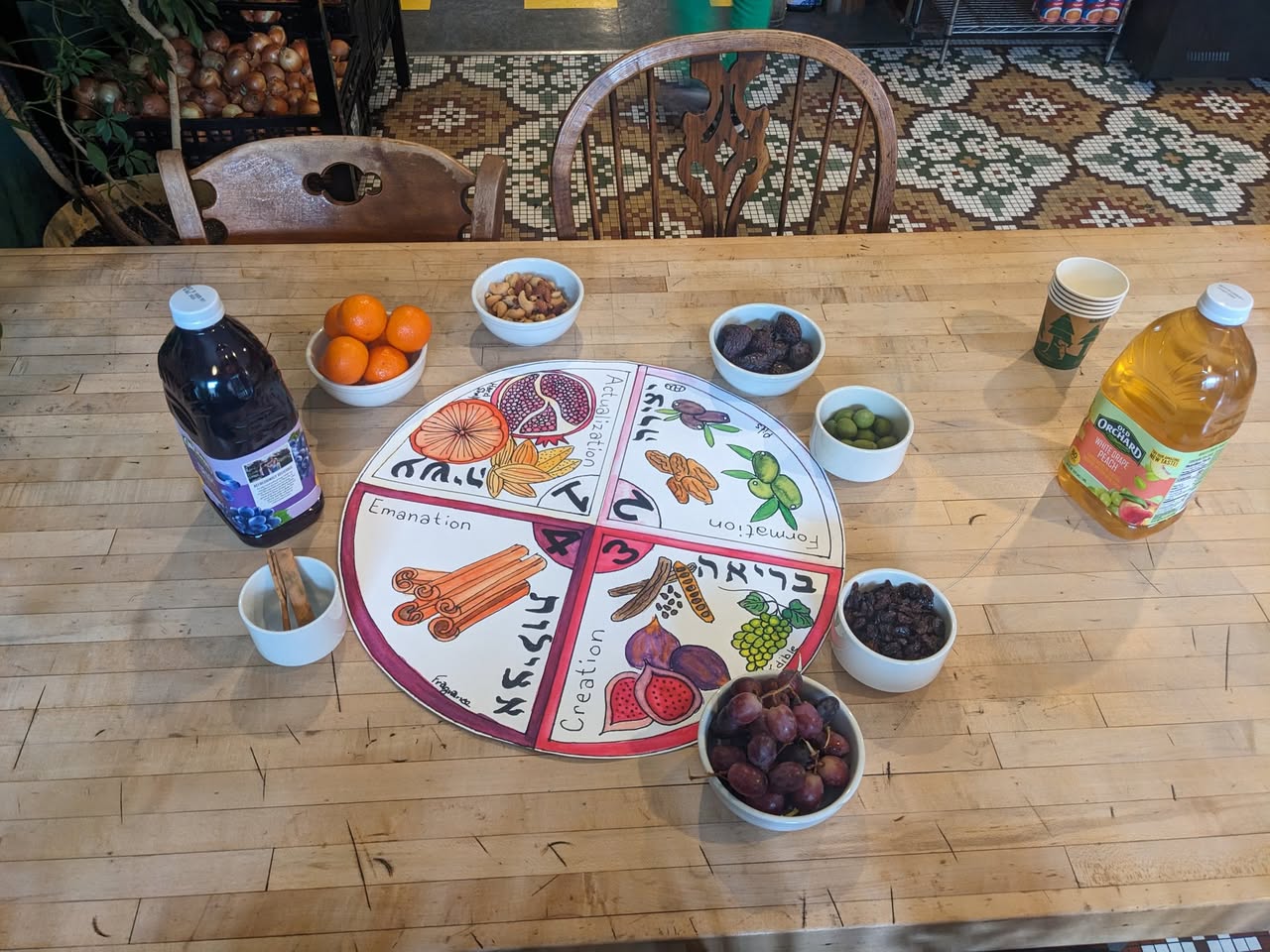
Today is Tu Bishvat, the Jewish holiday that centers a spiritual connection with the land and reminds us of our obligation and oportunity to care for it. As part of the Seder I led this morning for Own Your Judaism and Tikkun Ha-Ir, I offered the following reflection questions for each of the four cups of grape juice and then a fifth question specifically for trees.

1st Cup: We often associate winter with barrenness. What blessings do you find in winter, in emptiness?

2nd Cup: As we connect last year with this year through the rebirth of spring, what do you want to carry forward with you from last year, and how can that form into a mindful practice?

3rd Cup: Growth is a gradual process. What is something that you have taken for granted in your growth, and how can you practice gratitude around it?

4th Cup: This is a cup symbolizing hope. What can you do to make the earth and the world–the litter ground–better and closer to our ideal?

Bonus Reflection on Trees: How do trees inspire you?

May this Tu Bishvat allow us to appreciate the gifts of the land and rededicate ourselves to its care and sustenance.

MINDFUL MESSAGE: Faith & Wealth

On Tuesday, January 20, 2026, I had the joy and honor of sharing Judaism’s perspectives on Faith & Wealth during a Zoom Webinar hosted by the Interfaith Conference of Greater Milwaukee. Here is what I shared (and, If you would prefer to listen to what I shared, please follow this link to the 7 minute and 45 second audio file):

“Thank you, Ahmed. Thank you also to everyone for the opportunity and the honor to be here and to share a little bit about the Jewish teachings and perspectives about wealth. My name is Moishe Steigmann, The Mindful Rabbi, and once again, it’s really an honor to be here.

In Judaism, wealth is not simply an economic category. It’s not simply about how much money I have, how much money I can get. Wealth is also a spiritual category. Judaism does not ask whether wealth is good or bad. Rather, Judaism asks, “What does wealth do to us? And in turn, what does wealth ask us to do for others?” So, wealth really is not neutral. It’s not even self-justifying. Rather, wealth is a test of values and a test of awareness. 

Truthfully, wealth itself is not considered a problem within Judaism. The Torah, in fact, recognizes material prosperity as a blessing. Every single day, we, as Jews, recite the amidah, which is the central prayer and Judaism, and one of those prayers asks for prosperity. We bless each other, we bless ourselves with abundance and with wealth. 

At the same time, Judaism does warn about what abundance can do to us as individuals and, in turn, the harmful effects that can have for society. First of all, we can forget vulnerability. We can get comfortable with the wealth that we have, the lives that we live, and forget those in our society who are in need of help. We can forget interdependence, that wealth is not achieved alone. We live in an interdependent world, and anything that I have gained is really also on the footsteps of so, so, so many others, both visible and often unseen. And we can forget God, community, and responsibility. Throughout the Torah, we are taught of our responsibility to give to others, to leave what we have for others. 

Instead, we grow attached to our wealth. Like in Islam, as Ahmed is suggesting, ownership in Judaism is conditional. Things do not belong to us and to us alone. Rather, we are taught that everything in the earth is the Lord’s. We are not absolute owners of anything. Rather, we are stewards. And yes, possession might be real in a tangible sense, and it is never ultimate. Judaism insists that even what I earn is not mine alone because no one earns in isolation. For instance, every single time after we eat food, in our grace after meals, we bless God, and we bless the land. I don’t have food just because I have money. I have food because of God and because of the land. We recognize that labor depends on society; markets depend on trust; success depends on randomness as much as effort. 

Wealth is something that we hold. It’s not something that we are. It’s not, “I am wealthy.” Rather, it’s, “I have wealth.” It’s not, “what did I do to deserve my wealth?” It’s, “what do I do with the wealth with which I am blessed?” 

The most common name to Jewish giving is tzedakah, and many of you may have heard that before. We often simplify and often mistranslate tzedakah as charity. Tzedakah is not the impulse to want to do something kind for someone else and to give them money. Rather, tzedakah comes from the Hebrew root word of tzedek, which is justice. Tzedakah is a societal, collective, and individual obligation.

Maimonides–Rambam–a 12th century Jewish theologian and scholar, talks beautifully about the hierarchy of tzedakah, and that tzedaha, the point is really to center dignity. Because one of the highest levels of tzedakah is giving and receiving anonymously, so no one is embarrassed in front of their fellow. And the highest level of tzedakah is helping someone find a job. Maimonides also reinforces the Jewish notion of tithing, giving 10 percent of one’s income. And fascinatingly. he also says that a Jew should not give more than 20 percent of their income. His justification is, lest they become impoverished themselves. Which, 800 years ago, makes sense. Maybe I give so much that I, in turn, become one who is needy. I can’t imagine, however, that maimonides could imagine, can understand the incomprehensible individual wealth that exists today. And so I think Judaism rather is focused on the core principles of sustainability and responsibility.

The question that Judaism forces us to ask today is whether ethical responsibility has scaled along with capacity. Judaism invites us to hold wealth with awareness rather than with anxiety, with gratitude rather than guilt, and with responsibility rather than entitlement. 

Indeed, I suspect–and I am so excited to hear whether my suspicion is accurate or misses the mark–I suspect that every faith represented here asks some version of the same question: “How do we live ethically and remain fully human in the presence of abundance?” And I wonder out of curiosity and mindful reflection, “What would change if we measured success not by what we accumulate rather by how awake we remain in the presence of abundance?”

And so it is my hope and blessing for each one of us that we are indeed prosperous. And that, in turn, we use our prosperity to embody the ideals, values, teachings, and traditions of each of our faith practices to our individual and collective responsibility to truly make the world a better and more just place.

Thank you.”
Top